
Views: 0 Author: Site Editor Publish Time: 2026-02-25 Origin: Site


Unexpected vibration in a Centrifugal Fan rarely appears without warning. It may start as a slight increase in noise, a minor fluctuation in airflow, or a subtle rise in bearing temperature. Over time, that vibration can escalate into severe mechanical stress, shortened component life, and unexpected shutdowns. For maintenance teams, installers, and plant managers, centrifugal fan vibration is not just a mechanical inconvenience — it is an operational risk that affects productivity, safety, and energy efficiency. The difference between temporary correction and long-term stability lies in identifying the root cause quickly and applying the correct fix in the right order. This guide provides a structured troubleshooting sequence designed to reduce downtime, prevent repeated failures, and improve system reliability.
When vibration is detected, many teams instinctively focus on the most visible component. However, vibration is often a chain reaction. Addressing only the visible symptom may leave the root cause untouched.
Rotational imbalance creates centrifugal forces that multiply with speed. Bearings are typically the first components to suffer. Excessive vibration causes uneven rolling contact, overheating, and surface fatigue. Shafts may gradually bend under oscillating loads, creating additional misalignment. Housing structures can develop stress fractures at weld points. Mounting bolts loosen over time, increasing instability. In severe cases, impeller-to-housing contact can occur, leading to catastrophic failure.
Even moderate vibration, if sustained, reduces service life dramatically. What begins as a small imbalance can lead to premature motor failure if left unresolved.
Replacing bearings without checking alignment, cleaning impellers without evaluating duct turbulence, or upgrading motors without examining structural resonance often results in recurring problems. Effective centrifugal fan vibration diagnosis requires sequence-based elimination rather than random replacement.
Structured inspection reduces unnecessary part cost and prevents repeat shutdowns.
Before performing mechanical checks, isolate power completely. Lockout and tagout procedures must be strictly followed. Rotating equipment can retain residual energy. Safe diagnosis prevents injury and protects equipment.
Imbalance remains the most frequent cause of centrifugal fan vibration across industrial applications.
Imbalance occurs when mass distribution across the rotating impeller becomes uneven. Dust buildup, corrosion, blade deformation, or missing balancing weights alter rotational symmetry. Even minor accumulation in one blade section can generate significant centrifugal force at high speeds.
In dust extraction systems, airborne particles often accumulate unevenly. In corrosive environments, blade edges may erode asymmetrically, gradually shifting balance.
Vibration intensity increases proportionally with rotational speed. Visual inspection may reveal debris accumulation. Operators may also notice that vibration reduces temporarily after cleaning.
Thorough cleaning should be performed first. After debris removal, inspect for cracked or bent blades. If imbalance persists, professional dynamic fan balancing restores symmetry. Proper balancing significantly reduces centrifugal fan vibration and extends bearing life.
Install filtration systems upstream when possible. Establish routine cleaning intervals based on operating environment. In dusty facilities, monthly inspection may be required. Preventive maintenance is far less costly than emergency replacement.
Fanova centrifugal fan designs allow convenient access for cleaning and inspection, minimizing maintenance downtime in extraction applications.
Misalignment between motor shaft and fan shaft produces consistent mechanical stress.
Even slight angular or parallel misalignment creates uneven radial loads. Bearings experience additional force, leading to heat generation and increased vibration. In belt-driven systems, incorrect belt tension amplifies oscillation.
Unlike imbalance, misalignment often generates vibration at predictable frequencies unrelated to airflow fluctuations.
Use alignment tools to ensure motor and fan shafts are precisely positioned. In belt systems, inspect pulley alignment and belt wear. Correct tension eliminates oscillation. After realignment, re-measure vibration to confirm reduction.
New installations should be rechecked after initial operating hours. Components settle under load, potentially altering alignment. Scheduled verification prevents progressive bearing damage.
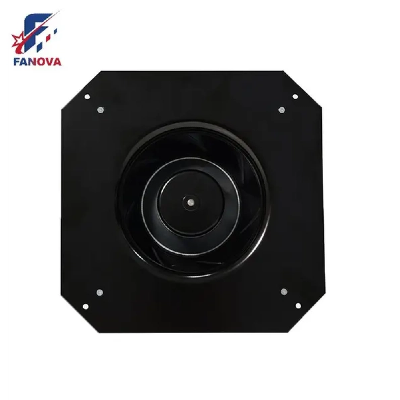
Bearings are critical load-bearing components and often the first to show signs of failure.
Gradual vibration increase, rising temperature near housing, and abnormal noise often signal lubrication degradation or bearing surface damage. Unlike imbalance, bearing-related vibration typically worsens slowly over time.
Replace worn bearings with correct specification units. Apply appropriate lubrication based on manufacturer guidance. Over-lubrication can be as damaging as under-lubrication.
Adopt runtime-based lubrication intervals rather than reactive maintenance. Thermal monitoring and vibration analysis provide early detection, reducing unplanned downtime.
High-quality centrifugal fan assemblies from Fanova are designed to support stable bearing operation under continuous industrial duty.
Structural weakness amplifies vibration, even when mechanical components are balanced.
Improper torque application, uneven foundation surfaces, or flexible base frames create vibration amplification. Structural movement increases oscillation and accelerates fatigue.
Retorque mounting bolts according to specification. Reinforce base frames if flexing occurs. Install stiffeners or vibration isolation pads when appropriate.
Support-bracket centrifugal fan designs integrate structural reinforcement into the assembly. This reduces installation variability and improves alignment stability. For example, Fanova’s 48V DC 133mm 42W model features a compact bracket-supported configuration optimized for stable high-speed operation in dust extraction environments.
Bracket support reduces stress concentration and enhances long-term operational consistency.
Not all vibration originates from mechanical imbalance. Aerodynamic instability can produce similar symptoms.
If system resistance increases due to clogged filters or closed dampers, airflow decreases while pressure rises. Operating outside the stable region of the performance curve creates fluctuating pressure waves.
These pressure oscillations generate vibration and audible pulsing.
Inspect system resistance elements such as filters and dampers. Adjust fan speed if necessary. In some cases, selecting a centrifugal fan better suited to the operating pressure range resolves the issue permanently.
Select a fan that operates near its optimal efficiency region. Operating within stable curve zones prevents stall-induced vibration.
Improper duct design frequently mimics mechanical imbalance.
Sharp elbows positioned too close to the inlet create uneven airflow distribution. Swirling airflow introduces fluctuating aerodynamic forces on the impeller.
These forces appear as vibration but originate from airflow instability rather than mechanical defects.
Increase straight duct length before the inlet. Smooth transitions between duct sections. Eliminate abrupt expansions or contractions.
Proper duct design reduces aerodynamic load variation and stabilizes operation.
Resonance occurs when operating frequency aligns with structural natural frequency.
Vibration amplitude peaks at specific speeds but reduces when speed changes slightly. Unlike imbalance, resonance is speed-dependent.
Modify structural stiffness or introduce vibration isolation. Adjust operating speed if feasible. Reinforcing duct structures can shift natural frequency away from operating range.
Resonance diagnosis requires careful observation but once corrected, stability improves dramatically.
Step | What to Check | Time Required | Corrective Action |
1 | Mounting bolts | 10–20 min | Retorque |
2 | Visible debris | 15–30 min | Clean impeller |
3 | Alignment | 30–60 min | Realign shafts |
4 | Bearings | 30–90 min | Lubricate or replace |
5 | Stall signs | 1–2 hrs | Adjust airflow/resistance |
6 | Duct layout | 1–3 hrs | Improve transitions |
7 | Resonance | Variable | Add isolation or reinforce |
Following this order prevents unnecessary disassembly and minimizes downtime.
Centrifugal fan vibration can be significantly reduced through disciplined installation, proper balancing, structural reinforcement, and operation within stable performance regions. Standardizing alignment checks, cleaning schedules, and mounting procedures prevents recurring failures. Selecting structurally reinforced centrifugal fan assemblies with bracket support enhances installation stability and reduces long-term vibration risk. If your system demands consistent performance and reduced downtime, contact Fanova (Suzhou) Motor Technology Co., Ltd. to discuss engineered solutions and identify the most reliable industrial airflow equipment for your facility.
Always inspect mounting and visible debris before replacing mechanical components.
Yes. Increased system resistance may push the fan into aerodynamic stall, creating vibration.
Balancing should be checked whenever cleaning, blade repair, or bearing replacement occurs.
Absolutely. Rigid bracket-supported designs improve installation consistency and reduce amplification.


