
Views: 0 Author: Site Editor Publish Time: 2026-02-18 Origin: Site


Selecting the right Centrifugal Fan is not a matter of comparing catalog airflow numbers or choosing the most powerful motor available. In real projects, the success of a ventilation or exhaust system depends on how precisely the fan matches the system’s resistance, operating conditions, and long-term performance expectations. When centrifugal fan selection is done correctly, it reduces energy waste, stabilizes airflow, minimizes vibration, and prevents premature maintenance. When done poorly, it leads to inefficiency, noise complaints, and costly redesign. This guide provides a structured approach that helps buyers translate practical needs into clear technical specifications, ensuring that the final selection delivers reliable performance in demanding environments.
A centrifugal fan never works independently. It becomes one component inside a larger airflow system that includes ducts, filters, silencers, dampers, enclosures, and sometimes complex extraction networks. The system determines how hard the fan must work and how efficiently it can operate.
Every centrifugal fan selection should begin with a clear understanding of the actual objective. Ventilation for livestock facilities requires stable airflow across large open spaces while resisting corrosive gases. Sewage station deodorization demands strong pressure capability and material durability in humid conditions. Dust extraction systems require consistent suction even as filters gradually load with debris. Cooling enclosed machinery requires compact designs with controlled noise output.
Defining the application in concrete terms immediately narrows the selection range. It clarifies whether efficiency, corrosion resistance, compact size, or pressure capacity should be prioritized.
Airflow and static pressure are the foundation of centrifugal fan selection. Airflow represents the volume of air that must move through the system. Static pressure represents the resistance that the airflow encounters. These two values define the duty point.
Ignoring static pressure is one of the most common causes of underperforming systems. Without accurate resistance estimation, even a high-capacity fan may fail to deliver the required airflow once installed.
Two systems may require identical airflow values, yet demand entirely different fans. A short, straight duct with minimal obstructions requires significantly less pressure than a long duct network with multiple bends and filters. Filters, grilles, heat exchangers, and silencers all add resistance. If the selected fan cannot overcome total system resistance, airflow drops below target levels, creating instability and inefficiency.
Proper centrifugal fan selection means evaluating airflow and pressure together rather than independently.
Many buyers focus heavily on airflow because it is easy to understand. Static pressure, however, is equally important and often overlooked.
Static pressure represents everything in the system that resists airflow. The longer the duct run and the more components involved, the greater the resistance. Every bend increases turbulence. Every filter introduces restriction. Every grille or damper modifies flow patterns.
When pressure is underestimated, the fan operates outside its optimal region. This may cause excessive noise, reduced efficiency, and mechanical stress.
An RFQ that only lists airflow but omits duct length, filter type, and layout details creates uncertainty in centrifugal fan selection. Clear documentation of system resistance allows accurate matching and stable operation.
A fan curve is not a technical barrier; it is a practical decision-making tool. Understanding how to interpret it empowers buyers to make confident selections.
A typical fan curve shows the relationship between airflow and static pressure. It also displays power consumption and efficiency across operating points. The intersection of system resistance and fan performance determines the actual operating condition.
The Best Efficiency Point, often referred to as BEP, indicates where the fan operates most efficiently and stably. Running close to BEP reduces vibration, lowers energy consumption, and extends service life. Selecting a fan that operates far from this point increases mechanical stress and operational noise.
Equally important is avoiding the unstable region of the curve. Operating near stall conditions can cause fluctuating airflow and vibration. In industrial settings such as sewage deodorization or livestock ventilation, instability directly affects system reliability.
Fanova designs centrifugal fans with performance curves optimized for stable operation within realistic industrial duty ranges. This ensures that once installed, the fan performs predictably under continuous operation.
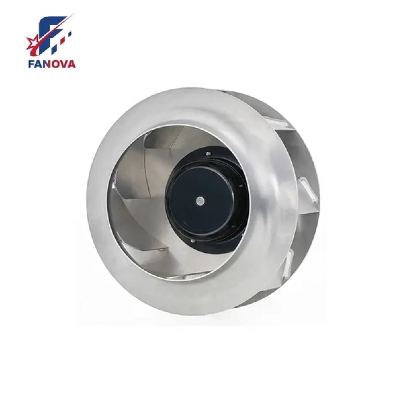
Impeller design strongly influences efficiency, noise level, and suitability for specific environments.
Clean air applications often allow greater flexibility in impeller selection. However, dusty or corrosive air demands durable blade structures and protective coatings. In environments such as livestock farms or sewage stations, humidity and chemical exposure can accelerate wear if materials are not properly treated.
Backward-curved impellers are commonly considered a safe default for medium to high pressure applications. They typically deliver higher efficiency and quieter operation compared to alternative designs. This makes them particularly suitable for industrial ventilation and deodorization systems.
Fanova’s 230V EC 280mm 410W backward centrifugal bracket fan is engineered for sewage station deodorization, combining efficient airflow with structural durability. Similarly, the 230V EC 400mm 700W model provides high ventilation performance for livestock and poultry farms where stable airflow and corrosion resistance are critical.
Forward-curved impellers can still be suitable in lower-pressure, compact installations where space constraints are strict. The key is ensuring that system resistance aligns with the chosen design.
Motor technology directly impacts efficiency, controllability, and operating expense.
EC motors offer significant advantages in industrial centrifugal fan selection. Their high efficiency and smooth speed control allow better performance under variable load conditions. For systems operating continuously, even small efficiency improvements translate into meaningful energy savings over time.
DC options are ideal for compact equipment, specialized voltage requirements, or battery-supported systems. These configurations allow flexible integration without sacrificing stability.
Providing complete electrical specifications in an RFQ ensures accurate product matching. Voltage, control method, ambient temperature range, and noise limits all influence final selection. Clear communication reduces delays and improves performance predictability.
Performance numbers alone do not guarantee success. Installation quality and structural stability strongly influence real-world results.
Noise typically originates from aerodynamic turbulence, structural vibration, or resonance caused by improper mounting. Selecting a fan that operates near its optimal efficiency point reduces aerodynamic noise. Using stable bracket and support designs reduces structural vibration transmission.
Fanova’s bracket-style centrifugal fans enhance mounting consistency and structural stability. Secure installation reduces vibration risk and improves long-term reliability.
Maintenance planning should also be integrated into centrifugal fan selection. Designs that allow easy cleaning and inspection reduce downtime. In dust extraction or agricultural applications, regular inspection of impellers and mounting bolts prevents imbalance and performance decline.
What you must define | Why it matters | What to provide in RFQ |
Required airflow | Determines fan size | Target airflow with tolerance |
Static pressure | Ensures sufficient pushing force | Duct length and layout details |
Air condition | Affects material choice | Humidity, dust, corrosive gases |
Noise target | Influences blade and speed strategy | Desired sound level |
Power and control | Determines motor configuration | Voltage and control method |
Installation space | Prevents fit issues | Dimensions and orientation |
Using this structured checklist ensures that centrifugal fan selection is data-driven and precise rather than speculative.
Successful high-quality centrifugal fan selection follows a simple yet disciplined workflow. First, define the system requirements clearly, including airflow and total resistance. Second, analyze the fan curve to confirm that the operating point lies within a stable and efficient region. Third, verify motor configuration, installation conditions, and maintenance accessibility. When these steps are followed carefully, the result is a reliable ventilation system that operates efficiently and consistently over time. If you are planning a new project or upgrading an existing system, contact Fanova (Suzhou) Motor Technology Co., Ltd. to discuss your requirements and identify the most suitable air moving solution for your application.
Airflow alone does not determine performance. Static pressure, system resistance, and efficiency region must also be evaluated to ensure stable operation.
Ideally, the operating condition should be near the Best Efficiency Point to minimize vibration, noise, and energy consumption.
EC motors offer higher efficiency and better controllability in many applications, particularly for continuous industrial operation.
Provide airflow requirements, estimated static pressure, voltage details, noise expectations, and installation dimensions to enable accurate matching.


