
Views: 0 Author: Site Editor Publish Time: 2026-06-18 Origin: Site


AI and cloud workloads generate unprecedented heat density in modern facilities. This thermal challenge pushes facility cooling costs up significantly. Cooling often comprises up to 40% of total energy consumption. Finding efficient ways to reject this massive thermal load is a top priority for operators. Liquid cooling systems frequently grab industry headlines today. However, optimized air cooling remains the true backbone of reliable heat rejection. Specifically, the high-volume, low-pressure characteristics of axial units handle the bulk of this continuous work. IT directors and facility engineers evaluate these arrays daily. They specify and upgrade systems to protect stringent Service Level Agreements (SLAs). You also want to lower your Power Usage Effectiveness (PUE). Reducing long-term operational expenses is equally crucial. This article explores how you can select and deploy the right air movement solutions. We will cover core deployment scenarios, efficiency upgrades, and crucial implementation risks.
Targeted Deployment: Axial fans excel in high-airflow, low-static-pressure environments like 42U server racks, fan walls, and as ambient redundancies in liquid-cooled facilities.
The EC Motor Advantage: Upgrading to an EC axial fan yields up to 30–50% operational energy savings compared to traditional AC motors, easily offsetting the ~15% higher initial CapEx.
Systemic Risk Mitigation: Advanced specifications—such as active Power Factor Correction (PFC) to reduce grid harmonics and resonance detection—prevent premature mechanical and electrical failures.
Clear Application Limits: Axial fans are not universal; high-resistance pathways (like deep ducts or heavy filtration) require centrifugal alternatives.
We must first define the aerodynamic boundary of these devices. Axial fans move air parallel to the rotating shaft. They generate massive volume, measured in Cubic Feet per Minute (CFM). They achieve this high volume at a relatively low static pressure. This physical trait dictates their primary application. They excel where air encounters minimal physical resistance. Engineers rely on them to push huge walls of air through open corridors and standard IT enclosures.
We can map this capability directly to core ventilation requirements. Modern processors produce immense heat under load. Facilities must move vast amounts of ambient air across hot heat sinks rapidly. If they fail to provide adequate data center ventilation, thermal throttling occurs instantly. CPUs and GPUs will downclock their performance to survive the heat. You need massive, uninterrupted airflow to prevent this performance drop. Efficient airflow management relies entirely on this continuous volume to maintain optimal operating temperatures.
You must frame equipment failure as a severe business risk. A broken heat dissipation fan is never just a mechanical issue. It causes immediate hardware degradation. It triggers unscheduled downtime across critical network nodes. Your business faces multi-million-dollar SLA penalty risks when servers go offline. Reliable air movement directly protects your revenue streams. Investing in high-quality cooling infrastructure guarantees continuous uptime for your most demanding enterprise clients.
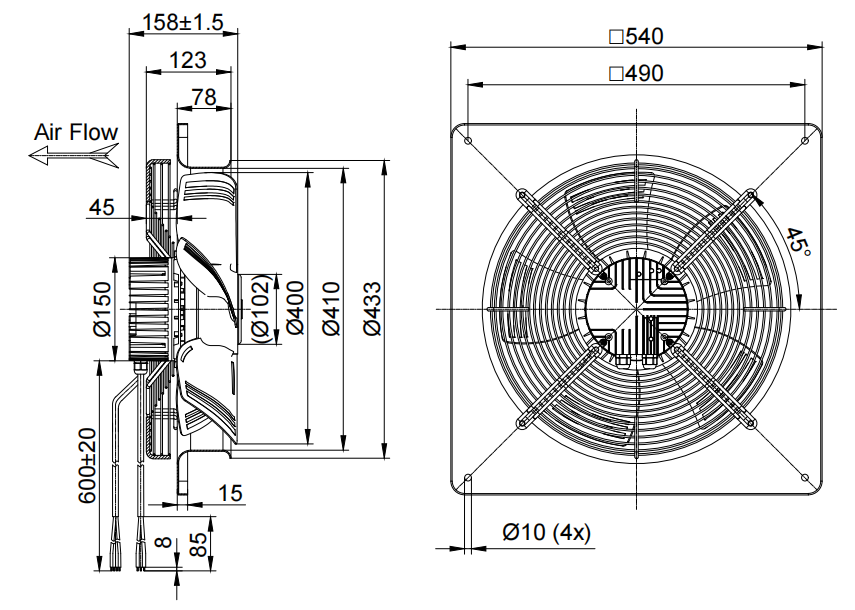
Implementation happens directly within standard 42U cabinets. Engineers use front-intake and rear-exhaust configurations. This creates a dedicated, high-velocity airflow path for each individual server chassis. The components pull cold air from the aisle and push hot exhaust out the back.
These applications demand strict design requirements. A modern server cooling fan must fit seamlessly into highly congested spaces. Here are the core requirements for rack-level implementation:
Compact Form Factors: Space inside a 42U cabinet is highly restricted. Components must maximize air output without wasting valuable server real estate.
Hot-Swappable Designs: Mission-critical maintenance requires replacing failed units instantly. Technicians must swap components without powering down the entire processing rack.
Dual-Ball Bearing Construction: AI servers demand continuous 24/7 high-RPM operations. Premium bearings survive these harsh operational stresses significantly longer than standard sleeve bearings.
Facilities increasingly use large fan arrays operating in parallel. These massive fan walls draw in external cold air from outside the building. They distribute it evenly across the data floor. They also reject hot exhaust efficiently back into the atmosphere. This method leverages natural outside temperatures to cool the IT load.
This implementation relies heavily on array redundancy. You do not run a few massive units at maximum load. Instead, you operate multiple smaller units in parallel at lower speeds. This strategy saves exponentially more power due to fan affinity laws. It also extends hardware lifespan significantly. If one unit fails, the building management system commands the others to dynamically ramp up and compensate.
Direct-to-chip liquid cooling handles intense processor heat effectively. However, it does not eliminate the need for traditional air cooling entirely. Liquid loops only capture heat from specific, targeted components like the CPU or GPU.
You still need axial units operating continuously in these environments. They dissipate residual ambient room heat effectively. They cool supplementary motherboard components, memory modules, and power supplies. They also provide critical system redundancy. If primary liquid loops require maintenance or suffer a leak, robust air ventilation keeps the facility operational until technicians restore the primary system.
We must contrast legacy AC induction motors with modern electronically commutated (EC) motors. AC motors suffer severe efficiency drops when operating at partial loads. They rely on outdated, mechanically inefficient designs. They consume excess power and generate unwanted secondary heat. This forces the room air conditioners to work harder just to cool the fan motors.
EC technology solves these inherent inefficiencies completely. It eliminates carbon brush friction through a brushless design. The motor integrates AC-to-DC conversion directly on the internal circuit board. This advanced design runs much cooler and lasts significantly longer. It allows for precise, infinite speed control based on real-time temperature demands.
Let us examine the CapEx versus OpEx reality. We assume a modern EC axial fan commands a 15% higher initial purchase price. However, it consumes up to 50% less electrical power at equivalent airflow volumes. The operational energy savings are massive and immediate. A facility upgrading an array of 1,000 units typically achieves full return on investment within a single fiscal year.
Comparison of AC and EC Fan Technologies | ||
Feature | Traditional AC Motor | EC (Electronically Commutated) Motor |
|---|---|---|
Energy Efficiency | Low (especially at partial loads) | High (up to 50% less power consumption) |
Speed Control | Limited, often requires external VFDs | Infinite, precise control via internal electronics |
Mechanical Wear | High (uses carbon brushes, generates friction) | Low (brushless design extends operational lifespan) |
Acoustic Noise | Higher operational noise | Significantly quieter operation |
Initial CapEx | Lower upfront cost | Approximately 15% higher purchase price |
Facilities often worry about adoption friction during upgrades. Fortunately, EC units offer simple drop-in replacement paths. They require no expensive infrastructure overhauls. They connect directly to your existing AC power grids without new wiring. They simply operate with superior DC-level efficiency internally. This makes retrofitting an entire data floor a straightforward maintenance task.
Airflow volume versus static pressure dictates your engineering choice. You must know exactly when not to use an axial unit. Does your airflow path include complex, winding ducting? Do you use thick CRAC filtration mats? Are heavy cable trays blocking the under-floor path? These physical elements create severe high static pressure. In these restrictive cases, centrifugal fans are the correct engineering choice. A standard Axial Fan for Data Centers pushes large volumes freely but cannot overcome severe system resistance effectively.
Consider strict acoustic compliance next. Many modern data centers sit near densely populated residential zones. Strict municipal noise regulations apply to these buildings. Engineers must evaluate aerodynamic blade designs carefully. Bionic or swept fan blades break up trailing wake currents efficiently. This advanced geometric design reduces acoustic signatures by 5 to 7 dB(A). It keeps your facility compliant with local noise ordinances without sacrificing cooling performance.
Robust IoT and BMS integration is also non-negotiable today. You must assess supported communication protocols thoroughly. Ensure the units support RS485, Modbus, and BACnet natively. Facilities need dynamic, sensor-driven speed adjustments across the entire floor. This automation eliminates localized hot spots instantly. It ramps up cooling only where sensors detect rising temperatures, saving massive amounts of facility power.
Engineers must navigate several highly technical risks during facility-wide upgrades. Mitigating these systemic issues prevents catastrophic failures and ensures grid stability.
Power Grid Harmonics (THD): EC motor adoption at scale carries a hidden electrical risk. Current harmonics can feed back into the facility power grid. You must specify active Power Factor Correction (PFC) on all new units. This internal correction keeps Total Harmonic Distortion THD(I) strictly below 2%. It improves power quality and reduces the required capacity for expensive backup generators.
Mechanical Resonance Fatigue: Specific operating RPMs naturally cause dangerous vibrations. These resonant vibrations destroy motor bearings rapidly over time. We highly recommend systems featuring automatic resonance detection. The onboard software detects these frequencies during commissioning. It then "skips" these critical frequency bands automatically during daily operation, preserving hardware life.
Refrigerant Safety Compatibility: Many modern facilities are transitioning to natural, low-GWP refrigerants to meet environmental goals. Propane (R290) is highly efficient but highly flammable. You must evaluate explosion-proof motor housings rigorously. Ensure thermal fail-safes strictly comply with EN 60335-2-40 standards. This guarantees the fan surface temperature never reaches the refrigerant ignition point during a fault.
We can summarize the procurement logic into a clear decision framework. You must calculate the required CFM for your specific heat load first. Next, assess the static pressure of your racks or enclosures. Finally, weigh the upfront equipment cost against the aggressive OpEx savings. EC technology pays for itself incredibly quickly through massive daily energy reductions. It represents the smartest investment for modern facility upgrades.
Facility managers should take specific, actionable next steps immediately. Request Computational Fluid Dynamics (CFD) thermal simulations from your vendors. Ask manufacturers to provide physical product samples for testing. Validate drop-in compatibility and acoustic performance on a small scale. Complete these validation steps thoroughly before committing your budget to a facility-wide retrofit.
A: Typical capacities range from 2,000 to 30,000 m³/h. The exact volume depends heavily on the form factor and specific application. Rack-level units provide targeted, lower volumes, while massive fan wall arrays deliver the highest end of this spectrum to cool entire data halls efficiently.
A: Yes, they handle these extreme loads effectively when specified correctly. AI infrastructure requires high-RPM units built with dual-ball bearings to survive continuous operation. Facilities often pair these robust air components with liquid cooling loops to manage the unprecedented thermal density of modern GPU clusters.
A: Upgrading usually delivers an 8-12% improvement in overall cooling efficiency. This realistically lowers the facility's Power Usage Effectiveness (PUE). However, achieving maximum savings depends heavily on implementing dynamic, sensor-driven speed control rather than running the units at a constant maximum speed.
A: Yes, you can replace them without electrical overhauls. EC fans function as direct drop-in replacements. They feature integrated AC/DC converters inside the motor housing. You simply connect them to your existing AC power grid, and they operate internally with superior DC efficiency.


