
Views: 0 Author: Site Editor Publish Time: 2026-06-12 Origin: Site


Selecting the wrong mechanical blower leads to severe system underperformance. It causes excessive energy consumption and guarantees premature motor failure. Engineers face a harsh reality when aerodynamic capabilities mismatch building layouts. We must get this specification right from the start. The primary physical distinction lies in how air enters and exits the housing. If you ignore these fluid mechanics, systems choke under pressure or waste massive power. It creates a cascading failure across the entire duct network. This guide provides facility managers and mechanical engineers an evidence-based framework. You will learn how to evaluate, specify, and procure the correct fan topology. We outline specific mechanical constraints to ensure your next project succeeds.
Axial fans excel in high-volume, low-static-pressure scenarios, offering a smaller footprint ideal for direct exhaust or cooling applications.
Centrifugal fans dominate in high-static-pressure environments, making them the standard for complex ductwork and heavily filtered commercial ventilation systems.
Evaluating the fan performance curve against your system's exact static pressure requirements is non-negotiable for efficient airflow control.
Integrating an EC fan (Electronically Commutated) motor into either design drastically reduces lifecycle energy costs and improves variable-speed scalability.
Every successful mechanical design begins with calculating system resistance. We measure this resistance as static pressure. Engineers typically record static pressure in inches of water gauge (in. w.g.) or Pascals (Pa). It represents the physical friction air encounters as it travels through a building. Ducts, dampers, filters, and cooling coils all restrict air movement. The fan must generate enough force to push through this restriction. If you underestimate static pressure, the system starves for air.
Fans overcome resistance using two distinctly different physical mechanisms. You must understand this aerodynamic divergence to choose the correct unit.
Axial Dynamics: This design moves air parallel to the rotating shaft. It relies entirely on propeller-based lift dynamics. Blades slice through the air and push it forward linearly. It moves massive volumes quickly but lacks brute pushing force.
Centrifugal Dynamics: This design pulls air in axially but discharges it radially. The air turns at a 90-degree angle inside the housing scroll. It utilizes centrifugal force to throw air against the housing wall. This rapid compression generates substantial pressure.
A specific blower is never universally efficient. It only operates efficiently at its designed operating point. We find this point on the manufacturer performance curve. You map the required air volume against the calculated system resistance. The intersection dictates your ideal selection. Operating outside this intersection causes aerodynamic stalling or mechanical overload.
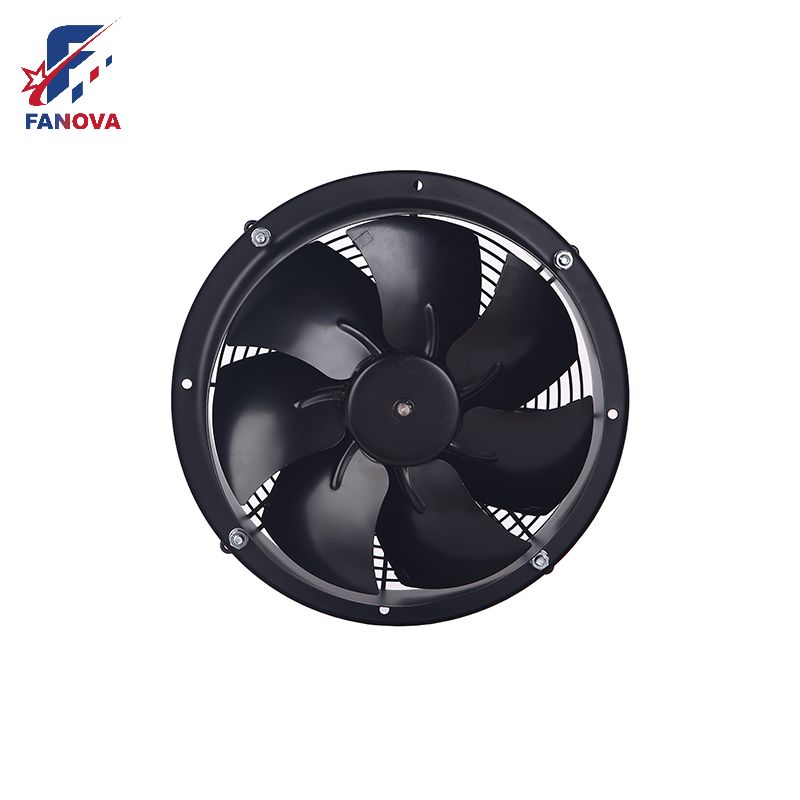
The core engineering profile of an axial unit prioritizes volume over pressure. They deliver high CFM (Cubic Feet per Minute) capacities against minimal system resistance. You deploy them when air faces very few physical obstacles.
Engineers categorize these units into three main variations based on housing geometry.
Propeller Fans: These feature basic blades mounted to a motor. They usually lack a deep housing. They exhaust air directly through walls.
Tube Axial: Manufacturers enclose the propeller inside a cylindrical tube. This improves directional flow and slightly increases pressure capabilities.
Vane Axial: These represent the most advanced category. They feature stationary guide vanes behind the impeller. Vanes straighten the swirling air stream. This recovers wasted kinetic energy and pushes efficiency higher.
You will specify these units for direct wall exhaust and large cooling towers. They act as the primary movers in outdoor condenser units. They dominate basic HVAC ventilation tasks where ductwork remains practically non-existent.
Their primary advantage stems from a highly compact footprint. They slide easily into existing pipe runs. They weigh significantly less than alternative designs and require less robust mounting hardware. However, severe risks exist. They remain highly prone to aerodynamic stalling. If you subject them to unexpected static pressure, the airflow collapses. For example, adding MERV 13 filters to an axial-driven system later will trigger extreme noise and system failure.
Centrifugal blowers serve a fundamentally different purpose. Their core engineering profile focuses on overcoming high resistance. Long duct runs, complex dampers, and advanced filtration demand immense pushing power. They supply this power consistently.
The shape of the internal blade determines the unit's efficiency and pressure ceiling. We classify them into three dominant profiles.
Impeller Type | Key Characteristic | Ideal Application |
|---|---|---|
Forward Curved | Lower operating speed, very quiet. | Residential furnaces and light commercial packaged units. |
Backward Inclined | Non-overloading power curve, highly robust. | Heavy industrial exhaust and large variable air volume systems. |
Airfoil | Peak aerodynamic efficiency, complex blade shape. | Large-scale primary air handling systems requiring strict energy compliance. |
You will invariably select centrifugal units for the primary air handling unit fan. They power large rooftop units (RTUs) across retail and industrial spaces. They serve as the undisputed standard for heavily ducted commercial ventilation networks spanning multiple floors.
The definitive advantage lies in stability. They maintain consistent performance under fluctuating pressure conditions. As filters load with dust, a centrifugal blower continues pushing air reliably. However, you must accommodate their structural demands. They require a much larger spatial footprint. They need dedicated mechanical room real estate and heavy-duty vibration isolation bases.
Procuring the right equipment requires rigorous metric evaluation. You cannot rely on dimensional sizing alone. You must cross-reference aerodynamic data against physical building constraints.
You must learn to read the manufacturer fan curve accurately. The curve maps CFM against static pressure. You plot your system resistance curve over the fan curve. The intersection represents your true operating point. Ensure this point falls within the highest efficiency zone of the blower. Operating too far left or right wastes electricity and overheats the motor.
Noise mitigation plays a crucial role in indoor environments. You must compare sound power levels across different models. Centrifugal designs generally offer better noise mitigation inherently. Their heavy housings contain acoustic energy. In contrast, axial configurations generate high-frequency tip noise. They usually require external duct attenuators or silencers to meet indoor acoustic standards.
Mechanical room square footage remains expensive. In-line axial models save critical floor space. You can suspend them directly within the ductwork ceiling grid. Centrifugal blowers demand dedicated floor space. Their scroll housings project outward, requiring specific inlet and discharge clearances. You must plan for these structural realities early in the architectural phase.
Modern building codes strictly regulate electrical consumption. ASHRAE 90.1 and local energy codes dictate minimum fan efficiency grades. Integrating a modern EC fan ensures immediate compliance. Electronically commutated motors eliminate traditional induction losses. They offer precise, variable airflow control without mechanical throttling. This drastically lowers energy usage during partial load conditions.
Specifying equipment based solely on day-one operation creates long-term hazards. Mechanical systems must survive decades of continuous operation. You must evaluate ongoing maintenance limits and operational durability.
Consider how facility teams will access belts, bearings, and motors. Traditional belt-driven configurations require constant tensioning. Belts stretch, slip, and degrade over time. This friction loss consumes extra electricity. Direct-drive configurations eliminate belts entirely. They mount the impeller straight to the motor shaft. This drastically reduces mechanical wear and lowers ongoing labor requirements.
The upfront hardware purchase represents a tiny fraction of the total operational burden. The vast majority of a blower's lifecycle footprint comes from electrical consumption. Frame your specification around continuous energy draw and potential downtime. A slightly cheaper unit that draws ten percent more power will penalize the facility heavily over twenty years.
Under-sizing equipment remains a common engineering failure. Buildings evolve. Facilities frequently upgrade to denser filters (like HEPA or MERV 15) to improve indoor air quality. These upgrades instantly increase system resistance. You must design with a 10-15% static pressure safety margin. This buffer accommodates future filter upgrades. However, avoid over-specifying blindly. Oversized motors running at low speeds suffer from severe efficiency drops.
We can distill complex aerodynamic theory into a practical decision matrix. Use these typical scenarios to guide your initial HVAC Fan selection strategy.
Project Requirement | Primary Obstacle | Recommended Fan Topology |
|---|---|---|
Scenario A: Move massive air volumes straight through a wall. Zero ductwork. | High volume needs, strict space limits. | Specify Axial. (Propeller or Tube Axial) |
Scenario B: Push air through a multi-story building. VAV boxes and HEPA filters present. | Extreme static pressure resistance. | Specify Centrifugal. (Backward Inclined or Airfoil) |
Scenario C: Upgrade an existing air handler unit. Space is tight, but high efficiency is required. | Footprint constraints, variable load demands. | Specify Plenum/Plug fans. (Centrifugal hybrid with EC motors) |
Begin by mapping the physical environment. Gather exact CFM requirements for every zone. Calculate the Total External Static Pressure (TESP) rigorously. Do not estimate this number. Once you finalize the resistance data, request detailed performance curves from manufacturers. Compare how different blade profiles react to your specific resistance metrics.
Neither fan topology is objectively superior in a vacuum. Success relies entirely on matching aerodynamic capabilities to the physical realities of the ductwork. If you ignore the friction inherent in a building layout, even the most expensive equipment will fail.
We encourage buyers to prioritize system performance curves over isolated hardware specifications. Look closely at how the blower handles pressure spikes. Evaluate the ongoing maintenance demands of the drive system. Prioritize long-term reliability and precise load matching. Always consult with a licensed mechanical engineer to run precise load and static pressure calculations before procuring heavy equipment.
A: Centrifugal fans generate significantly higher static pressure due to their radial airflow and housing scroll design. This centrifugal force easily overcomes heavy duct and filter resistance. In contrast, an axial fan lacks this compressive force. Pushing an axial unit against high resistance causes aerodynamic stalling and severe airflow loss.
A: Yes, EC motor retrofits are highly common in commercial upgrades. Engineers frequently install direct-drive plug fans equipped with EC motors into existing air handler cabinets. This improves efficiency and precise airflow control without requiring you to replace the entire outer sheet metal housing.
A: Axial fans typically generate higher noise levels, especially at higher speeds. They create harsh blade tip turbulence. This noise worsens dramatically if the unit is forced to push against unintended static pressure. Centrifugal units generally operate quieter because their heavy external scroll housings help contain acoustic energy.
A: They feature a "non-overloading" power curve. This means the motor will not draw excessive amperage and burn out if system resistance suddenly drops (e.g., if a duct access door blows open). This inherent electrical stability ensures operational safety and prevents catastrophic motor failure in large-scale applications.


