
Views: 0 Author: Site Editor Publish Time: 2026-06-04 Origin: Site


Selecting industrial fans is never a simple hardware purchase. It operates as a critical system-level decision defining your operational success. Choosing the wrong fan profile leads to severe consequences. You face excessive energy consumption, premature motor failure, and inadequate exhaust. Neither technology claims objective superiority. The correct choice depends entirely on mapping performance curves. You must match the equipment to exact aerodynamic resistance and spatial constraints. We designed this framework to guide facility managers, EPC contractors, and OEM engineers. Rigorous evaluation prevents costly engineering mistakes. In this guide, you will uncover essential airflow mechanics. We will dissect performance limits and critical implementation risks. You will finally learn how to specify the exact impeller design your infrastructure demands.
The Resistance Rule: Axial fans excel in high-volume, zero-to-low resistance environments; centrifugal fans are mandatory for overcoming high static pressure in ducted systems.
Performance Ceilings: Heavy-duty axial units can push excess of 800,000 m³/h, while centrifugal blowers can overcome extreme static pressures up to 25,000 Pa.
Risk Mitigation: Deploying a forward-curved centrifugal fan in a zero-resistance application can cause the motor to over-amp and burn out, while an axial fan forced against high resistance will experience a sharp drop in efficiency and a spike in turbulence noise.
Compliance Matters: Modern OEM applications must factor in Fan Energy Index (FEI) compliance and specialized materials (e.g., FRP for corrosive environments).
Understanding internal aerodynamics is the first step in fan selection. The fundamental difference lies in how each impeller interacts with the air stream.
Every axial flow fan operates on a straightforward principle. Propeller-style blades draw air in. They then discharge it parallel to the rotating shaft. This aerodynamic design mimics an airplane propeller. It creates a linear flow path from intake to exhaust. This architecture offers a specific baseline capability. It excels at moving massive volumes of air across open spaces. The motor requires minimal power draw when operating at free delivery. You gain maximum volumetric efficiency when system impedance remains negligible.
The centrifugal principle utilizes a radically different approach. Air enters axially toward the center of the rotating impeller. The blades then accelerate this air radially outward. A 90-degree angle dictates the final discharge path. The surrounding housing, known as a volute, captures the outward flow. It converts high-velocity kinetic energy into static pressure. This capability transforms the unit into a powerful blower. It generates highly pressurized, directional airflow. You need this intense pressure to push air through dense HEPA filters or complex duct runs.
You must establish a critical heuristic before evaluating performance curves. We call this the "Ducted vs. Non-Ducted" rule. Does your ventilation system lack ductwork? Open factory exhaust setups usually do. If so, start your evaluation with axial designs. Does your setup rely on extensive ducts, volume dampers, and thick filter banks? These components create significant friction. You should default to a centrifugal unit in these high-resistance scenarios.
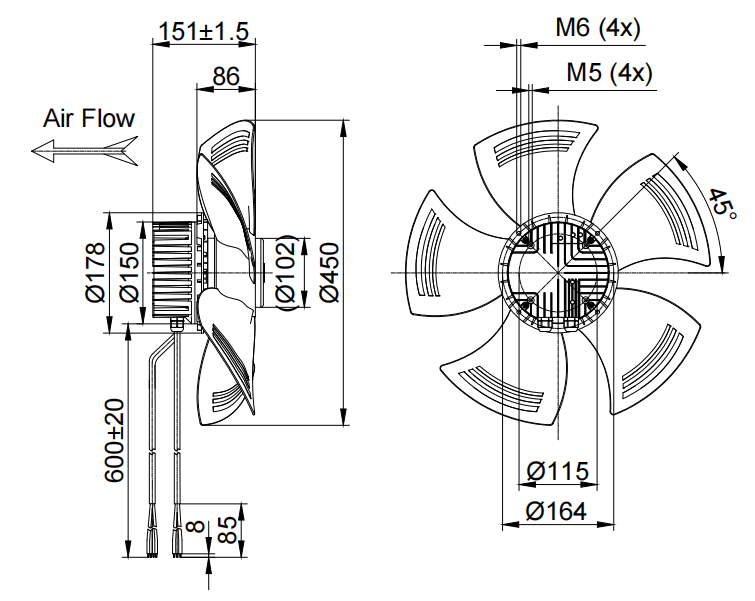
A rigorous centrifugal fan comparison against axial designs requires specific metrics. You cannot rely on general assumptions. We evaluate them across five primary engineering dimensions.
Axial designs provide unmatched capacity for raw air turnover. Their geometry allows them to push immense CFM (cubic feet per minute) relative to their diameter. A heavy-duty axial unit easily clears large factory floors. Centrifugal units generate a lower total volume. However, they deliver a highly concentrated, steady stream. They prioritize force over pure volume. You must match this airflow performance to your specific thermal load.
System resistance dictates pressure requirements. An axial fan's performance drops sharply when system resistance increases. The blades lose their grip on the air column. Conversely, centrifugal fans thrive in these conditions. They easily overcome the high static pressure found in industrial environments. A robust centrifugal blower can handle pressure drops exceeding 25,000 Pa. Axial variants stall long before reaching a fraction of that limit.
Efficiency remains relative to the system curve. No single fan type is universally more efficient. Axial fans achieve peak electrical efficiency at free delivery. They waste energy if forced to fight backpressure. Centrifugal fans behave differently. They achieve optimal energy efficiency when pushing against calculated system impedance. Backward-inclined centrifugal models offer the highest efficiency for ducted applications.
Acoustic profiles dictate installation locations. Axial models run quietly in open air paths. However, they suffer from severe tip-turbulence if forced against resistance. This turbulence causes sharp, disruptive noise spikes. Centrifugal units are naturally louder at the source. Their high-velocity mechanical action generates significant sound. Fortunately, this noise is predictable. You can easily attenuate it using silencers within closed, ducted systems.
Physical space often dictates equipment choices. Axial fans boast a linear, highly compact footprint. They slide easily into tight OEM constraints. You will find them in server racks and shallow HVAC units. Centrifugal fans require a much larger installation footprint. The scroll housing adds considerable bulk. OEM integrators must carefully design custom-engineered volutes to accommodate them.
Engineering Metric | Axial Flow Fan | Centrifugal Blower |
|---|---|---|
Volumetric Output | Exceptionally high (up to 800,000 m³/h) | Moderate to high, highly concentrated |
Static Pressure | Low (steep performance drop off) | Extreme (up to 25,000 Pa) |
Peak Efficiency Point | Free delivery / zero resistance | High system impedance / ducted |
Acoustic Behavior | Quiet in open air, loud under pressure | Loud but easily attenuated in ducts |
Integration Footprint | Compact, linear, shallow profile | Bulky, requires custom scroll housing |
Specifying the wrong technology guarantees premature system failure. You must understand how these impellers react to mismatched environments.
Engineers often fall into a dangerous trap with centrifugal blowers. They run a forward-curved centrifugal fan without attached ductwork. This setup offers zero resistance. The power curve of a forward-curved blade rises aggressively as pressure falls. Without backpressure, the impeller moves too much air mass. The motor works exponentially harder. It immediately over-amps, overheats, and burns out. You must always run forward-curved blowers with their minimum designed system resistance.
A different failure mode plagues mismatched axial units. You might attach an axial fan to a high-resistance filter or a long, narrow duct. The pressure exceeds the fan's maximum threshold. Aerodynamic stall occurs along the blade surface. Airflow plummets to near zero. The motor continues spinning, but it merely churns the trapped air. It wastes massive amounts of energy fighting aerodynamic stall. Vibration increases drastically, eventually destroying the shaft bearings.
Abrasive airstreams dictate your maintenance schedule. Axial fans offer straightforward maintenance. Their simple construction allows for rapid blade inspection. However, airborne particulates easily damage their exposed motors. Centrifugal fans demonstrate superior durability in harsh conditions. They keep the motor isolated from the primary airstream. This mechanical complexity serves a vital purpose. They handle particulate-heavy or abrasive air streams without compromising the drive motor.
Best Practice: Always use variable frequency drives (VFDs) to soft-start heavy centrifugal blowers.
Best Practice: Monitor the amperage of forward-curved fans during initial ductwork commissioning.
Common Mistake: Installing axial fans behind dense cooling coils and expecting nominal airflow.
Common Mistake: Removing ductwork from a centrifugal exhaust without adjusting the motor limits.
Industrial applications demand specialized materials and strict regulatory adherence. You cannot rely on off-the-shelf commercial components for severe environments.
Different sectors favor distinct aerodynamic profiles. Axial dominates the industrial cooling landscape. You will find them heavily utilized in localized heat exchangers. They serve as the primary movers in outdoor condenser units and large paint booths. Their volume-centric design perfectly cools expansive surfaces.
Centrifugal designs dominate heavy processing environments. They power massive dust collection facilities. They drive highly corrosive chemical scrubbers. Pneumatic conveying systems rely entirely on their high-pressure capabilities to move bulk materials through pipes.
Standard carbon steel fails in specialized environments. You must specify appropriate material executions. Facilities handling combustible dust require ATEX-certified explosion-proof builds. These utilize non-sparking brass or aluminum rub rings. Food and beverage processing demands AISI 304 or 316 stainless steel to maintain hygiene standards. Wastewater treatment plants face highly corrosive hydrogen sulfide gas. They rely exclusively on fiberglass reinforced plastic (FRP) housings and impellers.
Modern engineering requires strict regulatory alignment. You must match the fan-motor combination to the correct operating point. The US Department of Energy and ASHRAE enforce the Fan Energy Index (FEI). This metric ensures your chosen unit performs efficiently at its designated duty point. Selecting an oversized axial unit just for safety margins violates modern energy codes. You must prove compliance to satisfy OSHA and municipal energy requirements.
B2B buyers and EPC engineers need an objective qualification framework. Use this rapid checklist to eliminate guesswork from your procurement process.
What is the calculated static pressure drop of the entire system?
Calculate the exact pressure loss in Pascals (Pa) or inches of water gauge (inWG). Include all ducts, elbows, coils, and filters. A drop above 250 Pa usually disqualifies standard axial designs.
Is the airflow requirement continuous or demand-driven?
Continuous systems benefit from backward-curved centrifugal fans. Demand-driven systems require smart impellers paired with responsive VFD controls.
Are there strict EMI (Electromagnetic Interference) limitations?
Medical devices and data centers possess strict EMI limits. EC (Electronically Commutated) axial fans often meet these constraints better than massive AC induction motors.
Does the infrastructure restrict weight or installation footprint?
Roof structures have maximum load-bearing capacities. Axial units weigh significantly less and install vertically, saving critical structural support costs.
Will the airstream contain high temperatures, moisture, or abrasive dust?
Air exceeding 400°C requires a specialized centrifugal fan. You need bifurcated designs or belt-driven blowers that remove the motor entirely from the dangerous airstream.
The debate between axial and centrifugal technologies has no universal winner. The system curve dictates the only correct answer. You must calculate your exact static pressure and volumetric demands first. Use an Axial Fan when you prioritize massive volume and mechanical simplicity. Switch to a centrifugal unit when you require static pressure, directional precision, and extreme durability against system resistance.
We recommend engaging a technical manufacturer during the design phase. Share your exact pressure calculations and environmental variables. Professional engineers will match the motor sizing and impeller geometry to your specific application. This rigorous approach prevents aerodynamic stall, stops premature motor burnout, and ensures your facility achieves optimal exhaust efficiency.
A: You can only replace it if you drastically reduce the system's static pressure. This requires removing extensive ducts or dense filters. If you leave the high-resistance infrastructure in place, the axial fan will stall. It will fail to move the required air, generate extreme turbulence, and eventually suffer bearing failure.
A: Industrial HVAC systems utilize deep cooling coils, long duct runs, and HEPA filtration banks. These components introduce massive aerodynamic resistance. Centrifugal fans consistently overcome this high static pressure. They push air through complex impedances without losing their electrical efficiency or stalling.
A: Standard scroll blowers include their own housing. However, motorized impellers function differently. These backward-curved centrifugal fans arrive without a scroll. OEM integrators must design the equipment's internal cavity properly. The surrounding chassis itself acts as the pressure-building housing to direct the radial airflow.


