
Views: 0 Author: Site Editor Publish Time: 2026-06-05 Origin: Site


Facility managers and HVAC engineers face immense pressure today. We must drastically reduce energy consumption. We also need to meet strict regulatory standards like ErP directives and ASHRAE guidelines. Traditional AC motors struggle under these demanding conditions. They suffer massive efficiency drop-offs at partial loads. This drastically inflates operational costs. It also makes precise environmental control nearly impossible. You need a reliable solution to stay compliant and profitable. Electronically commutated (EC) technology offers the perfect answer. It represents the modern baseline for commercial ventilation. These advanced systems seamlessly balance high-volume air movement with precise variable speed control. In this article, you will discover the core engineering advantages of this technology. We explore how smart controls and optimized aerodynamics deliver unmatched operational benefits. You will also learn practical criteria for evaluating these systems. Finally, we cover implementing them effectively in both new builds and retrofits.
EC technology combines the benefits of AC voltage supply with the high efficiency and control of DC motors.
Upgrading to an EC axial fan typically yields up to 30-50% energy savings compared to traditional AC equivalents, heavily impacting ROI.
Intelligent, built-in control systems allow for seamless integration with Building Management Systems (BMS) without requiring external Variable Frequency Drives (VFDs).
Evaluating a low energy fan requires looking beyond just wattage to consider acoustic profiles, lifespan, and Total Cost of Ownership (TCO).
We see a massive shift across modern facilities. Global regulations now demand greener building footprints. Modern energy saving HVAC systems rely heavily on EC technology. It helps buildings easily exceed stringent efficiency directives. European ErP regulations set a very high bar for motor efficiency. North American ASHRAE standards push similar compliance goals. Traditional motors consume vast amounts of electricity. They quickly become financial liabilities. Upgrading legacy systems is no longer optional. It is a strict regulatory requirement.
You must also consider Operational Expenditure (OpEx). Most ventilation systems rarely run at maximum capacity. They spend most hours operating at partial loads. AC motors lose massive efficiency when throttled down. They consume excess power. They generate unwanted heat. EC motors maintain high efficiency across their entire speed range. You see a direct correlation between this efficiency and reduced utility bills. Facility managers often report immediate drops in monthly energy expenses.
Buyers often hesitate at the higher upfront cost. Initial capital expenditure is certainly higher. However, you must evaluate the long-term financial return. The break-even point typically arrives within one to three years. Continuous operation yields massive energy savings over time. You also spend significantly less on routine maintenance. You secure long-term financial performance by looking past the initial sticker price.
5-Year Lifecycle Expense Comparison | |||
Cost Category | Traditional AC Fan | EC Motor Fan | Financial Impact |
|---|---|---|---|
Initial Purchase (CapEx) | Lower | Higher | Higher initial investment required for EC units. |
Energy Consumption | High (Poor partial load efficiency) | Low (Optimized partial load efficiency) | 30-50% reduction in utility billing. |
Maintenance Costs | High (VFD tuning, heat wear) | Low (Brushless, runs cooler) | Fewer service calls and part replacements. |
Overall Expense (5 Years) | Significantly Higher | Significantly Lower | EC technology pays for itself rapidly. |
Traditional AC induction motors rely on magnetic slip. They induce current in the rotor. This process creates inherent energy losses. Engineers call these copper losses. They waste valuable energy as heat. EC motors eliminate this problem entirely. They use permanent magnets in the rotor. They operate synchronously without any slip. This fundamental engineering change transforms performance.
Consider the performance differences under varying loads. AC motors experience a sharp decline in efficiency at lower speeds. EC motors maintain a high efficiency plateau. You can throttle them down significantly. They still operate highly efficiently. This makes them perfect for variable demand environments.
Chart: Efficiency Curve Analysis (Typical Values) | ||
Operating Speed (RPM) | AC Motor Efficiency (%) | EC Motor Efficiency (%) |
|---|---|---|
100% Speed | 75% | 90% |
80% Speed | 60% | 88% |
60% Speed | 45% | 85% |
40% Speed | 30% | 80% |
Legacy systems often require external Variable Frequency Drives (VFDs). VFDs add unnecessary complexity. They require shielded cables. They generate harmful electrical noise. A modern EC Axial Fan features built-in commutation electronics. It does not need an external VFD. It simplifies your electrical wiring. You eliminate multiple potential failure points in the electrical panel.
We also must look at airflow optimization. Engineers pair the motor and impeller aerodynamically. They design blades to maximize cubic feet per minute (CFM). The fan overcomes specific system static pressures effortlessly. The integrated electronics monitor load changes. They adjust power dynamically. This precise pairing ensures optimal air delivery under all conditions.
Noise matters immensely in commercial spaces. Hospitals and offices require quiet environments. AC motors driven by VFDs often emit a loud magnetic hum. This noise travels through ductwork. EC technology optimizes the electronic commutation. It smooths out the power delivery. This drastically reduces annoying operational noise. Manufacturers also use specialized blade geometries. They sweep the blades to cut air quietly. The result is a much quieter facility.
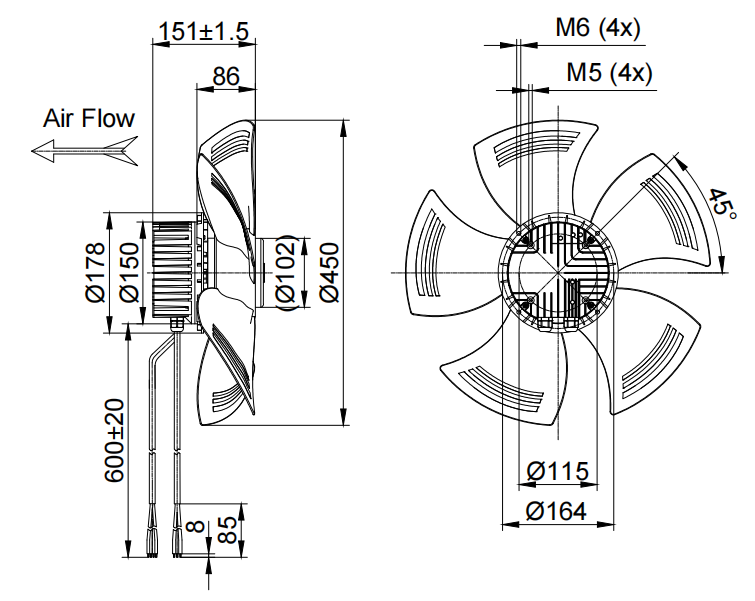
Mechanical rooms often lack extra space. Rooftop installations have strict weight limits. EC motors utilize an external rotor design. The motor sits directly inside the impeller hub. This creates a highly compact footprint. They feature a much shorter axial length compared to traditional motors. You can build slimmer air handling units. Installers face fewer challenges in constrained spaces. It makes retrofitting tight spaces significantly easier.
Heat destroys bearings over time. AC motors generate significant internal heat due to copper losses. EC motors run much cooler. Lower operating temperatures protect the internal electronic components. This directly reduces wear on the mechanical bearings. You get an extended maintenance-free lifecycle. A typical unit operates reliably for tens of thousands of hours. Facility teams spend less time replacing worn-out equipment.
You must match fan specifications to your exact environment. Data centers require massive electronics cooling. They need high CFM capabilities. You must also build in system redundancy. Agricultural facilities face different challenges. They deal with dust, ammonia, and extreme moisture. You must evaluate ingress protection carefully. Look for IP55 or higher ratings for these harsh spaces. Condenser units sit outside. They need strong corrosion resistance. Selecting a robust low energy fan ensures reliable operation regardless of the environmental challenges.
Smart buildings demand smart HVAC components. EC technology offers plug-and-play control systems. Most units accept standard 0-10V or PWM control inputs. You can seamlessly scale their speed based on sensor data. Modern facilities also utilize advanced communication protocols.
These units often support Modbus RTU or RS485 connections. These protocols enable predictive maintenance strategies. Facility managers can monitor critical data remotely. They track RPM, motor temperature, and power consumption in real-time. You detect minor issues before they cause catastrophic failures. This intelligence transforms how we manage building infrastructure.
Replacing legacy AC fans requires careful planning. You must evaluate the structural and electrical realities of your site. Old fans often use bulky square frames. Newer units might not fit perfectly. You need to prepare for potential bottlenecks. Keep these structural considerations in mind:
Custom mounting plates may be necessary to adapt circular EC frames to square AC openings.
You must route standard AC mains directly into the fan. The internal electronics handle the DC conversion automatically.
Existing control signals might need a simple adapter to interface with 0-10V inputs.
Clearances around the fan must allow for adequate airflow to prevent choking.
Procurement teams need an evidence-oriented approach. Use a strict checklist when shortlisting suppliers. Follow these proven steps to secure the best equipment:
Verify all third-party acoustic and airflow performance data. Never rely solely on marketing claims.
Ensure the manufacturer provides localized technical support. You will need expert help during installation.
Require clear lifecycle calculation models before making a final purchasing decision.
Confirm communication protocol compatibility with your existing Building Management System (BMS).
Avoid the costly trap of over-specification. Legacy fan nameplates often show outdated or inflated performance numbers. Do not blindly order a replacement based on old labels. Measure your actual system resistance first. Use accurate static pressure readings. Selecting an oversized unit wastes your capital budget. It also forces the fan to run at inefficiently low speeds. Choose the exact right size based on your current operational data.
Transitioning to an advanced EC axial fan represents a fundamental engineering upgrade. It is no longer just a "green" initiative for modern buildings. It is a strict requirement for reliable, cost-effective operations. You achieve significant power reductions. You gain precise environmental control. You also drastically lower your long-term maintenance burdens.
Take action today. Audit your top energy-consuming ventilation assets. Identify older AC units running continuously. Reach out to specialists for a custom retrofit analysis. Upgrading your air circulation systems will deliver immediate operational improvements. It secures your facility's financial future and ensures compliance with upcoming energy regulations.
A: No. They run on a standard AC mains supply. The motor features an internal rectifier. It converts the incoming AC power into DC power automatically. You do not need expensive specialized power supplies. This makes retrofitting older AC systems straightforward and highly cost-effective.
A: Standard AC fans use VFDs to vary speed. However, VFDs cause efficiency losses. They generate excess motor heat. They also produce electrical noise. Integrated EC electronics solve these issues. They offer superior partial-load efficiency. They run cooler and operate much quieter than a traditional VFD setup.
A: Yes. Most modern units feature built-in smart controls. They easily accept standard 0-10V or PWM signals. Many also support Modbus RTU and RS485 protocols. This allows seamless integration into your BMS for real-time monitoring and precise automated control.
A: These motors feature a brushless design. This makes them largely maintenance-free. Your primary concern is the bearing life. Under specified ambient temperatures and normal operating conditions, high-quality sealed bearings often last upwards of 40,000 hours without requiring manual lubrication or replacement.


