
Views: 0 Author: Site Editor Publish Time: 2026-06-20 Origin: Site


Moving air might seem like a straightforward mechanical task. Yet, selecting the wrong equipment creates cascading system failures. Incorrect specifications disrupt daily operations and cause severe facility headaches. It often leads to inadequate cooling and severely poor indoor air quality. Premature motor burnouts quickly become a constant, frustrating reality for maintenance teams.
The core engineering challenge lies in balancing airflow volume against static resistance. Every duct, elbow, damper, and filter creates a unique pressure drop. You must overcome this physical resistance to maintain optimal system performance.
This article provides an objective, evidence-based framework for making the right choice. You will learn how to evaluate system demands, structural limitations, and performance curves carefully. We guide facility managers and engineers through the rigorous selection process. You can confidently source the exact air pressure fan needed for your specific facility requirements.
Centrifugal blowers excel in high-pressure, ducted systems with high static resistance (e.g., filtration, complex exhaust routing).
Axial fans are optimized for moving high volumes of air at low pressure (e.g., open space cooling, general exhaust).
The blower vs fan decision ultimately hinges on calculating your system's exact static pressure requirements and footprint limitations.
Total Cost of Ownership (TCO) considerations must factor in maintenance access, energy efficiency at the required duty point, and noise mitigation.
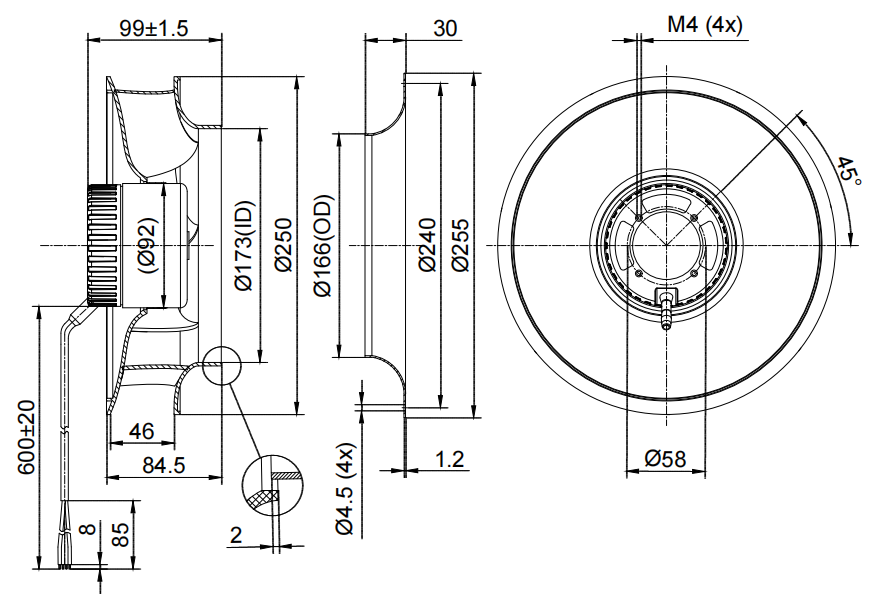
We must first examine the foundational aerodynamics of moving air. Different impeller designs interact with air molecules in vastly different ways. Understanding these physics helps you predict performance accurately.
Axial designs utilize a classic propeller-like mechanism. They draw ambient air in and force it out parallel to the rotational shaft. This parallel motion moves large volumes of air highly efficiently. The blades slice through the air, pushing it forward continuously.
However, this parallel design carries a severe limitation. It remains highly inefficient at overcoming downstream resistance. If backpressure increases, the airflow easily stalls. The aerodynamic grip on the blades breaks down completely. Air begins spinning harmlessly around the propeller instead of moving forward. You cannot force air through tight spaces using this parallel method.
Centrifugal units operate on an entirely different mechanical principle. Engineers often describe them as having a paddlewheel mechanism. Air enters the direct center of the rotating impeller wheel. Centrifugal force then grabs the air and throws it outward. This outward expulsion happens at a sharp 90-degree angle.
This perpendicular airflow provides a massive mechanical advantage. The rigid housing naturally compresses the air as it spins. This rotational compression generates significantly higher static pressure. It pushes air forcefully through severe obstructions.
You will often encounter specific terminology in industrial catalogs. A radial blower represents a specialized classification of centrifugal equipment. Manufacturers design them specifically for exceptionally harsh environments. They handle heavy particulates, wood chips, and industrial dust effortlessly. The straight blade design prevents sticky material buildup.
Installing axial units in heavy particulate streams. Dust coats the parallel blades, ruining the aerodynamic balance quickly.
Ignoring the pressure drop of protective grilles. Even simple wire guards reduce parallel airflow capabilities.
Evaluating performance requires looking at strict mathematical data. Fan curves map out exact capabilities under various conditions. They plot air volume on the X-axis and static pressure on the Y-axis. A rigorous airflow comparison prevents costly specification errors.
Axial equipment delivers massive volume at very low static pressure. Their performance curve appears relatively flat. A tiny increase in system resistance causes a massive drop in airflow. They simply lack the compression power to push through heavy blockages.
Conversely, centrifugal models provide variable volume at exceptional static pressure. Their fan performance curve looks much steeper. It remains highly stable under fluctuating system resistance. If your HEPA filters get dirty, the airflow drops only slightly. The machine continues pushing air reliably despite the increased drag.
Motor protection demands careful attention during selection. Axial fan motors risk severe overloading if airflow becomes blocked. The motor draws excessive electrical current trying to move stalled air. It overheats rapidly and fails prematurely.
Specific centrifugal wheel designs behave very differently. Backward-inclined blades offer built-in, non-overloading characteristics. They naturally protect the electrical motor. If system resistance drops suddenly, the power requirement peaks and then declines. The motor never draws more current than its maximum rated capacity.
Acoustic profiles differ significantly between the two designs. You must plan for noise mitigation early in the project.
Axial Noise: They generate lower-frequency throbbing sounds. This low-frequency noise travels great distances. It penetrates concrete walls and floors easily. Mitigation requires heavy, expensive silencers.
Centrifugal Noise: They generate much higher-frequency rushing sounds. Higher frequencies dissipate faster. They are also much easier to muffle. The heavy ducted enclosures naturally absorb these sound waves effectively.
Metric Category | Axial Design | Centrifugal Design |
|---|---|---|
Air Volume (CFM) | Exceptionally High | Moderate to High |
Static Pressure | Low (Under 1-2 inches WG) | Very High (Often up to 20+ inches WG) |
Fan Curve Profile | Flat and sensitive to changes | Steep and highly stable |
Acoustic Frequency | Low frequency (harder to block) | High frequency (easier to attenuate) |
Matching the machine to the environment guarantees success. A robust industrial ventilation setup requires absolute precision. We categorize applications based on the physical resistance they generate.
You should specify these high-pressure units for complex infrastructure. They dominate in specialized engineering scenarios.
Extensive Ductwork: Systems featuring long duct runs, sharp elbows, or complex transitions create immense drag.
Dense Filtration: Applications requiring air pushed through restrictive media. HEPA filters, heavy dust collectors, and wet scrubbers fall into this category. The equipment must force air through tiny porous openings.
Heavy Industrial Processes: Boiler combustion air relies heavily on forced draft pressure. Pneumatic conveying systems require massive static pressure to transport raw materials. Localized high-velocity extraction hoods depend entirely on this targeted suction power.
You should specify these volume-focused units for open-air challenges. They excel when obstructions remain minimal.
General Ambient Cooling: Warehouses and large manufacturing floors use them extensively for basic air circulation.
Direct Exhaust: Wall-mounted exhaust units remove stale air directly outside. Roof ventilators expel trapped heat from vast ceiling spaces. Large evaporative cooling towers rely on them to draw massive air volumes across water fills.
Open Space Transfers: Scenarios transferring air from one large open room to another. They perform flawlessly when moving air encounters zero physical resistance.
Every facility presents unique physical and logistical challenges. Spatial constraints dictate many engineering decisions. The blower vs fan debate often centers on practical installation limitations.
Axial models remain highly compact and space-efficient. You can mount them directly inline within standard circular ductwork. This straight-through approach saves valuable facility floor space. They slide easily into tight ceiling plenums or narrow wall cavities.
Centrifugal units demand a significantly larger physical footprint. They require distinct concrete mounting bases and heavy vibration isolators. Their specific inlet and outlet configurations demand careful spatial planning. The mandatory 90-degree turn alters ducting layouts entirely. You must account for these large space requirements during the early design phases.
Motor placement severely impacts long-term reliability. Axial motors usually sit directly inside the primary airstream. This internal placement risks severe, rapid damage. Hot, corrosive, or particulate-laden air flows constantly over the motor casing. Unless engineers specifically isolate the motor, the internal bearings and windings degrade rapidly.
Centrifugal motors typically sit completely outside the main airstream. This external placement makes them vastly superior for harsh duty environments. They exhaust hazardous chemical fumes safely. High-temperature gases never touch the sensitive electrical components. Maintenance mechanics can access the motor easily for routine lubrication without opening the main ductwork.
Energy utilization relies strictly on operational efficiency. Machine efficiency depends entirely on your exact duty point. You must operate near the Best Efficiency Point (BEP) on the manufacturer's curve.
Mismatching the equipment wastes massive amounts of electricity. A struggling axial unit consumes excess power trying to overcome heavy resistance without actually delivering results. Proper alignment ensures optimal energy utilization. It prevents wasted electrical draw and reduces thermal stress on the system.
How do we finalize the engineering selection? Follow this straightforward, four-step evaluation process. It eliminates guesswork and secures reliable performance.
This remains the absolute, non-negotiable first step. You must tally the physical resistance of every component. Calculate the drag from ducts, elbows, louvers, and dampers. Factor in the pressure drop of clean filters. Add a safety margin for when those filters eventually become dirty. If the total pressure exceeds typical axial limits, a Centrifugal Blower becomes your mandatory default choice.
Calculate the exact Cubic Feet per Minute (CFM) needed. Different industrial spaces require different air change rates. A chemical storage room needs more frequent air changes than a dry goods warehouse. Define this volumetric target clearly.
Assess the air quality meticulously. Is it clean, ambient room air? Does it contain heavy particulate matter or sticky residue? Are there corrosive chemical vapors present? High temperatures or caustic gases automatically push you toward externally motorized centrifugal solutions.
Review your available installation real estate carefully. Decide between compact inline ducting and large floor-mounted platforms. Ensure adequate clearance exists for future maintenance access. Mechanics need room to pull impellers and replace heavy drive belts.
We strongly advise consulting an experienced HVAC engineer before ordering. They will plot your specific system resistance curves mathematically. They then overlay these precise calculations against manufacturer fan curves. This rigorous analytical step guarantees success before final procurement.
Choosing the correct equipment prevents systemic facility failures. "Better" air pressure unequivocally belongs to the centrifugal design. It generates the raw compressive force needed for complex, highly restrictive systems. However, "better" ventilation requires matching the tool accurately to the exact environment.
You must measure system resistance carefully. Conservative static pressure calculations prevent disastrous, underperforming installations. Rushing the calculation phase always leads to operational bottlenecks. Follow the structured evaluation steps closely. Prioritize structural constraints over initial assumptions. Engage professional engineering support for final verification. By doing so, you secure reliable, long-lasting performance for your entire facility.
A: Yes, you can arrange contra-rotating axial fans in series to boost static pressure. However, this introduces significant mechanical complexity. It increases maintenance burdens and causes efficiency losses compared to using a single, properly sized centrifugal unit. We generally recommend avoiding series installations for high-pressure demands.
A: Forward-curved wheels scoop air forward. They move high volumes at lower speeds but handle only clean air at lower pressures. Backward-inclined wheels lean away from the rotation. They operate at higher speeds, offer greater energy efficiency, handle higher pressures, and feature non-overloading motor characteristics.
A: Aerodynamic stall occurs when downstream resistance becomes too strong. The backpressure forces the air boundary layer to separate from the propeller blade profile. The blades lose their grip on the air. Instead of moving forward, the air simply churns in place around the spinning hub.


