
Views: 0 Author: Site Editor Publish Time: 2026-02-19 Origin: Site


Debates around Centrifugal Fan design often focus on one simple question: should you choose a forward curved or backward curved impeller? For HVAC contractors, OEM engineers, and industrial buyers, the answer is rarely about preference. It is about pressure requirements, energy efficiency, noise tolerance, dust conditions, and long-term reliability. Understanding the structural differences between forward curved centrifugal fan designs and backward curved centrifugal fan configurations allows decision makers to match the blade type to real system constraints instead of relying on marketing claims. This guide provides a practical, application-focused comparison to help you select the correct blade type for stable, efficient operation.
Before examining performance trade-offs, it helps to understand what blade curvature actually changes inside a centrifugal fan.
In any centrifugal fan, air enters near the center of the impeller and is accelerated outward by rotational force. The direction in which the blades curve affects how the air leaves the impeller and how pressure is generated. Forward curved blades are oriented in the direction of rotation, producing a high volume of air at relatively low pressure. Backward curved blades are oriented opposite to rotation, generating higher pressure capability and improved aerodynamic efficiency.
This difference in airflow acceleration directly influences how the fan behaves under load. It affects efficiency, power consumption, and response to system resistance.
No blade style is universally superior. Performance depends on where the fan operates along its curve. If the system requires moderate to high static pressure due to long ducts or filtration components, backward curved designs typically perform more reliably. If the application involves short ducts and low resistance, forward curved centrifugal fans may achieve acceptable airflow at lower initial cost.
Understanding your system’s resistance profile is the foundation of making the right choice.
Energy efficiency often determines long-term operating cost. Over thousands of operating hours, small differences in aerodynamic performance can translate into substantial savings.
Forward curved centrifugal fan configurations are commonly used in low-pressure systems where compact size is important. However, their blade geometry often leads to lower peak efficiency compared to backward curved designs. When system resistance increases, forward curved impellers can consume more power relative to delivered airflow.
For applications where energy cost is a primary concern, this efficiency gap becomes significant over time.
Backward curved centrifugal fan models typically offer higher aerodynamic efficiency and improved power characteristics. Their performance curves often demonstrate stable efficiency across a broader operating range. This makes them particularly suitable for continuous industrial operation, where predictable energy consumption and stable airflow are essential.
Fanova (Suzhou) Motor Technology Co., Ltd. develops backward curved centrifugal fans optimized for efficient ventilation performance. For example, the 110V DC 225mm 144W quiet backward centrifugal bracket fan is designed to deliver stable airflow with low energy consumption, making it suitable for exhibition halls and similar commercial environments requiring quiet performance.
Efficiency claims should always be validated by reviewing the fan curve. Look for an operating point near the best efficiency region. If the required airflow and pressure fall far from this region, the fan may experience unnecessary power draw and mechanical stress.
Proper curve evaluation ensures that blade selection aligns with system demand rather than catalog assumptions.
Static pressure defines how hard a fan must work to move air through a system. Blade type strongly influences pressure capability.
Forward curved centrifugal fan designs can be practical in systems with minimal duct resistance. Small bathroom ventilation, compact air handling units, and short duct installations often fall into this category. In such scenarios, airflow demand is moderate and pressure resistance remains low, allowing forward curved designs to perform efficiently within their intended range.
In industrial ventilation systems, pressure resistance typically increases due to long ducts, bends, and filtration equipment. Backward curved centrifugal fan configurations are better suited to these conditions. They handle higher static pressure more effectively and maintain stable airflow as resistance fluctuates.
Fanova’s 24V DC 225mm 115W backward centrifugal air blower fan is engineered for ventilation in small bathrooms and enclosed spaces, offering efficient airflow while maintaining stability even when moderate resistance is present. For more demanding applications, bracket-supported backward curved models provide structural durability and higher pressure performance.
Selecting blade type without considering system resistance can result in unstable airflow and excessive energy consumption.
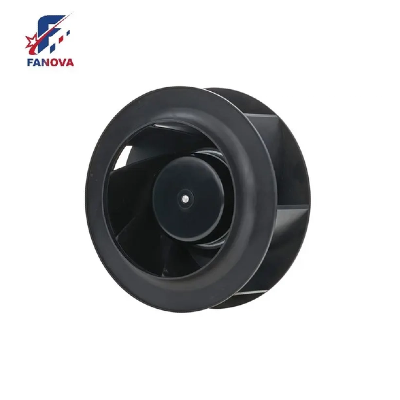
Noise performance is an important consideration, particularly in commercial and residential environments.
Backward curved centrifugal fan designs often operate more quietly at comparable duty points because of smoother airflow separation and reduced turbulence. When operating near their optimal efficiency range, they produce less aerodynamic noise.
However, noise is not solely determined by blade geometry. Installation conditions significantly affect acoustic performance. Poor mounting structures, resonant duct connections, and abrupt transitions can amplify vibration and noise. Even the best impeller design will perform poorly if installation quality is neglected.
Fanova’s bracket-style centrifugal fans are engineered to improve mounting stability. A secure structural base reduces vibration transmission and contributes to quieter overall operation. Combining efficient blade geometry with stable installation results in more comfortable acoustic performance.
Air quality often determines which blade style is more suitable.
Forward curved blades, due to their geometry, can be more sensitive to dust accumulation and debris buildup. In dusty or greasy environments, this may lead to imbalance over time, increasing vibration and maintenance requirements.
Backward curved centrifugal fan designs typically demonstrate better tolerance to moderate dust conditions. Their blade structure often reduces buildup accumulation compared to forward curved alternatives. For industrial extraction systems where air may contain particulates, this difference can influence long-term maintenance cost.
When selecting a fan for dusty environments, buyers should also evaluate material coatings, accessibility for cleaning, and inspection convenience. Fanova integrates corrosion-resistant materials and durable finishes into its centrifugal fan solutions to enhance longevity in challenging conditions.
Motor protection is a practical concern that often goes overlooked during blade selection.
Forward curved centrifugal fans may experience higher overload risk when system resistance decreases unexpectedly. For example, if filters are removed or dampers are adjusted, airflow may increase beyond intended limits, leading to excessive power draw.
Backward curved centrifugal fan designs generally exhibit more stable power characteristics. Their performance curves often show non-overloading tendencies within designed operating ranges. This makes them safer for systems where resistance may vary over time due to filter loading or operational adjustments.
When evaluating centrifugal fan options, buyers should confirm available power margin, thermal protection features, and speed control compatibility. Proper motor selection ensures safe operation under changing system conditions.
Decision Factor | Forward-Curved | Backward-Curved |
Best-fit systems | Low pressure, compact installations | Medium to high pressure ducting |
Efficiency trend | Generally lower peak efficiency | Higher aerodynamic efficiency |
Noise trend | May increase at higher resistance | Often quieter at stable duty |
Dust tolerance | More sensitive to buildup | More robust under moderate dust |
Overload risk | Higher if resistance drops | More stable power behavior |
Typical application | Small ventilation units | Industrial and commercial systems |
This comparison highlights that blade type should match application constraints rather than generalized assumptions.
The question of which centrifugal fan blade style is better becomes straightforward once system requirements are clearly defined. Evaluate static pressure first, then examine efficiency and noise expectations, and finally consider air quality and maintenance conditions. Backward curved centrifugal fan configurations often provide a safer general-purpose solution for medium to high resistance systems, while forward curved designs may suit compact, low-pressure installations. By aligning blade type with real operating constraints, buyers achieve stable airflow and long-term efficiency. For high-efficiency ventilation builds and bracket-supported designs, explore Fanova’s backward curved centrifugal fan range and contact us to discuss your project requirements and identify the most suitable ventilation blower for your application.
The primary difference lies in blade orientation. Forward curved blades prioritize airflow volume at lower pressure, while backward curved blades offer higher pressure capability and improved efficiency.
In many medium-to-high pressure applications, backward curved designs achieve higher efficiency. However, actual efficiency depends on operating point and system resistance.
Backward curved centrifugal fans generally handle moderate dust conditions more effectively due to reduced buildup sensitivity, though proper material selection remains essential.
Higher system resistance favors backward curved designs because they maintain stable airflow and power characteristics under pressure load.


