
Views: 0 Author: Site Editor Publish Time: 2026-02-26 Origin: Site


Energy consumption in industrial HVAC systems is driven not only by airflow requirements, but by how effectively mechanical energy is converted into useful air movement. Understanding how to evaluate Centrifugal Fan efficiency provides engineers, procurement managers, and energy analysts with a transparent method to compare equipment fairly and reduce long-term operating cost. Rather than relying on rated wattage or marketing specifications, calculating real fan efficiency reveals how much input power becomes useful airflow and how much is lost to aerodynamic and mechanical inefficiencies. This article explains the full calculation process, clarifies where data originates, demonstrates practical examples, and highlights the engineering factors that influence real-world performance.
Efficiency in ventilation systems must be defined precisely. In HVAC engineering, efficiency represents the ratio between useful air energy delivered and total energy consumed. Without understanding what qualifies as useful energy, calculations can become misleading.
Air power is the mechanical energy imparted to the air stream to overcome system resistance. It reflects the work done to push air through ducts, filters, coils, dampers, and terminal devices. This is the useful output of the fan.
Shaft power is the mechanical power transmitted from the motor to the impeller. It is higher than air power because aerodynamic losses occur inside the fan housing.
Electrical input power is the energy drawn from the power supply. It includes motor inefficiency, electrical losses, and mechanical friction.
Therefore:
Electrical Input > Shaft Power > Air Power
Understanding these layers is critical. When performing fan power calculation, it is important to clarify which input value is being used. Comparing air power to shaft power yields mechanical efficiency. Comparing air power to electrical input yields overall efficiency, which is more relevant for HVAC energy budgeting.
Many procurement decisions mistakenly compare motor wattage as an indicator of strength or performance. However, two centrifugal fans rated at 400 watts may deliver completely different airflow under identical pressure conditions. One fan may operate at 70 percent efficiency while another operates at 55 percent efficiency. Over thousands of operating hours, that 15 percent difference significantly affects electricity cost.
Performance must be judged by output relative to input, not by input alone.
Industrial ventilation systems often operate 8,000 hours or more annually. If a fan consumes an additional 200 watts continuously due to poor efficiency, annual energy waste can exceed thousands of kilowatt-hours. Over the lifespan of the system, efficiency becomes one of the most influential cost variables.
Fanova (Suzhou) Motor Technology Co., Ltd. integrates aerodynamic optimization and advanced EC motor technology to improve overall efficiency in demanding industrial HVAC environments.
Centrifugal fan efficiency can be calculated with a straightforward equation, provided that accurate inputs are available.
Air Power equals airflow multiplied by total pressure rise.
Air Power = Q × ΔP
Where:
Q = airflow in cubic meters per second
ΔP = total pressure rise in Pascals
For example, if airflow equals 1.5 m³/s and pressure rise equals 800 Pa:
Air Power = 1.5 × 800 = 1200 W
This 1200 watts represents the useful energy delivered to the air stream.
Input power may be measured electrical input or shaft power. For practical HVAC analysis, electrical input is typically used.
If electrical input equals 1800 W:
Efficiency = 1200 / 1800 = 0.67 or 67%
One of the most common calculation errors arises from incorrect unit conversion. Airflow must be converted from m³/h to m³/s when necessary. Pressure must be expressed in Pascals. Power must be in Watts.
Even small unit mistakes can lead to dramatically incorrect efficiency conclusions.
Accurate efficiency calculation requires trustworthy data. Engineers must avoid inventing numbers or assuming ideal conditions.
Total pressure rise must be determined at the actual operating point. This value is found by intersecting the system curve with the fan performance curve. Manufacturers provide detailed performance curves showing airflow versus pressure and power.
For example, Fanova’s 230V EC 280mm 410W backward centrifugal bracket fan designed for sewage station deodorization includes performance data that allows engineers to determine real pressure rise at specific airflow levels. This ensures accurate air power calculation.
Airflow values come from ventilation design standards, air change requirements, extraction volume calculations, or thermal load analysis. Using free-air delivery values instead of design airflow leads to inflated efficiency results.
Efficiency varies across the performance curve. Near the Best Efficiency Point, aerodynamic losses are minimized. As airflow moves away from this region, efficiency decreases.
Therefore, efficiency should always be evaluated at the intended duty point, not at peak efficiency under laboratory conditions.
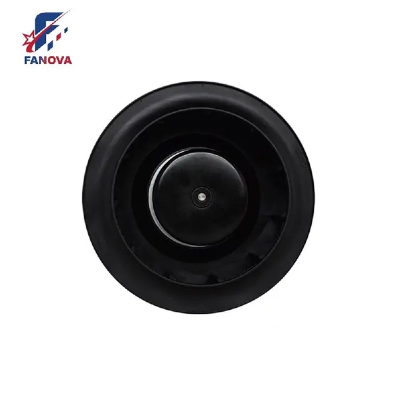
True comparison requires identical conditions.
When evaluating two centrifugal fans, ensure both are assessed at the same airflow and total pressure. Comparing peak efficiency of one fan to a different operating point of another is misleading.
Only when airflow and pressure are identical can input power differences reveal efficiency advantages.
Operating near BEP reduces turbulence and vibration. Fans running close to BEP typically demonstrate longer bearing life and smoother acoustic performance. Selecting a fan whose duty point lies near BEP enhances both efficiency and reliability.
Speed control modifies the fan curve. EC motors allow precise speed adjustment, enabling the fan to maintain efficient operation under partial load conditions. In variable-demand HVAC systems, this adaptability significantly influences annual energy consumption.
Fanova integrates EC motor solutions to optimize part-load efficiency and maintain stable airflow under dynamic conditions.
Fan affinity laws provide valuable predictive tools for estimating performance changes.
When rotational speed changes:
Airflow changes proportionally to speed.
Pressure changes proportionally to speed squared.
Power changes proportionally to speed cubed.
This cubic relationship means that small speed increases produce large power increases. Conversely, reducing speed slightly can significantly lower energy consumption.
If fan speed is reduced by 10 percent:
Airflow reduces by 10 percent.
Pressure reduces by approximately 19 percent.
Power reduces by approximately 27 percent.
This explains why variable speed control dramatically improves part-load efficiency.
Affinity laws assume constant air density and identical impeller geometry. Significant changes in temperature, altitude, or system configuration reduce predictive accuracy. Always validate final values against manufacturer performance data.
Even properly calculated systems may experience reduced efficiency due to installation conditions.
Sharp duct elbows, undersized duct diameters, and clogged filters increase pressure rise beyond design values. This shifts operating points away from BEP and increases input power.
Leakage in duct joints reduces effective airflow while the fan continues consuming power, decreasing system efficiency.
Turbulent airflow entering the fan creates uneven blade loading, increasing aerodynamic loss and reducing efficiency.
Using oversized motors that operate far below optimal load may decrease electrical efficiency.
Addressing these factors ensures calculated efficiency translates into actual performance.
Procurement decisions influence long-term operating cost.
EC motor technology provides improved efficiency across load ranges. In HVAC systems with fluctuating airflow demand, EC solutions minimize wasted energy.
Investing in smooth transitions and proper duct sizing reduces static pressure requirements, lowering required air power.
Selecting extremely low-speed operation to reduce noise may push the fan away from BEP. Balanced selection ensures acoustic comfort without sacrificing efficiency.
Input | Symbol | Example Value | Explanation |
Airflow | Q | 1.8 m³/s | Derived from HVAC load |
Total Pressure Rise | ΔP | 950 Pa | From performance curve |
Air Power | Pair | 1710 W | 1.8 × 950 |
Electrical Input | Pin | 2400 W | Measured input |
Efficiency | η | 71.25% | 1710 / 2400 |
If another fan delivers the same airflow and pressure but consumes 2700 W, its efficiency drops to 63 percent. Over continuous operation, this difference can result in thousands of dollars in additional energy cost.
Assume a fan operates 8,000 hours per year.
If efficiency difference causes an additional 300 W consumption:
Annual excess energy = 0.3 kW × 8,000 h = 2,400 kWh
Over 10 years:
24,000 kWh additional consumption
This example demonstrates why accurate centrifugal fan efficiency calculation influences capital investment decisions.
Calculating right centrifugal fan efficiency transforms HVAC selection from assumption to engineering precision. Define airflow, determine pressure rise, compute air power, divide by electrical input, and validate performance at the duty point on the curve. Incorporate control strategy and system resistance into evaluation. When efficiency becomes a measurable design parameter rather than a marketing claim, HVAC systems operate more reliably and economically. For projects requiring energy-conscious design and stable performance, contact Fanova (Suzhou) Motor Technology Co., Ltd. to discuss operating conditions and identify the most suitable industrial ventilation system solution for your facility.
Mechanical efficiency compares air power to shaft power. Overall efficiency compares air power to electrical input.
Because efficiency varies across the performance curve, and only the duty point reflects real operating conditions.
Yes. Due to affinity laws, reducing speed lowers power consumption significantly in variable load systems.
Higher resistance increases required air power and shifts operating point away from optimal efficiency.


