
Views: 0 Author: Site Editor Publish Time: 2026-02-15 Origin: Site


Industrial dust control systems succeed or fail based on pressure stability, not just airflow volume. At the core of every high-performance dust extraction system sits a Centrifugal Fan, responsible for overcoming duct losses, separator resistance, and filter loading while maintaining consistent capture velocity at every pickup point. In woodworking shops, metal processing plants, pharmaceutical facilities, and grain handling operations, dust collection performance directly affects equipment reliability, worker health, regulatory compliance, and fire safety. Understanding how centrifugal fans interact with static pressure, filtration behavior, and system design allows buyers to specify the correct dust collection fan and avoid performance decline over time.
Dust collection systems are often discussed in terms of airflow capacity. However, airflow alone does not determine capture performance. The true challenge lies in maintaining sufficient static pressure to move air through a constantly resisting network of ducts and filtration components.
Every component in a dust collection system introduces resistance. Capture hoods create entry pressure loss as air is drawn into the system. Ducting adds friction loss proportional to length and diameter. Elbows introduce turbulence, increasing localized pressure drop. Cyclone separators create centrifugal separation forces that require additional pressure. Cartridge or bag filters create significant resistance, which grows progressively as dust accumulates.
Unlike simple ventilation systems, dust collection networks frequently include long horizontal runs, multiple branch connections, and heavy filtration stages. This makes total static pressure substantially higher than many standard HVAC applications.
Imagine a metal fabrication plant with six welding stations connected to a central dust collector. Each station requires a defined capture velocity to remove fumes effectively. The system includes 30 meters of duct, multiple bends, a pre-separator, and a cartridge filter bank. Initial static pressure may reach 1500 Pascals. As filters load, this may increase to 1800 Pascals.
If the fan cannot sustain airflow at these pressure levels, capture velocity decreases, allowing fine particles to remain airborne. This illustrates why dust collection performance depends heavily on pressure capability.
Centrifugal fans are specifically suited for high-resistance systems because their impeller geometry enables them to generate higher static pressure compared to axial alternatives. Backward-curved centrifugal designs are particularly effective for dust collection due to their efficiency stability and pressure tolerance. Their performance curves allow predictable operation under varying resistance, making them the preferred dust collection fan choice in industrial facilities.
Fanova (Suzzhou) Motor Technology Co., Ltd. develops centrifugal fan solutions optimized for pressure-intensive applications such as dust and harmful gas extraction, ensuring consistent airflow even under challenging conditions.
Dust systems are dynamic. Unlike clean-air ventilation, filtration resistance increases continuously as particles accumulate.
As filter loading increases, the system curve shifts upward. The operating point of the centrifugal fan moves along its performance curve. Without variable speed control, airflow gradually decreases while pressure rises.
This shift reduces capture efficiency and may push the fan toward less stable operating regions. Understanding this interaction between system curve and fan curve is essential for maintaining consistent performance.
Filter loading changes static pressure gradually, often unnoticed. Operators may not detect airflow reduction until visible dust escapes from hoods. By this stage, performance degradation has already affected workplace air quality.
Install differential pressure sensors across filter banks to monitor resistance growth. Establish maintenance intervals based on pressure threshold rather than calendar dates. Integrating speed control via EC motor technology allows compensation for moderate pressure increase while maintaining airflow.
Fanova’s centrifugal fans equipped with EC motor options provide adaptability in such dynamic dust collection environments.
Effective centrifugal fan selection for dust collection must account for more than airflow capacity.
Capture velocity requirements depend on dust type and particle weight. Heavy metal particles require different airflow characteristics compared to fine wood dust. Calculating airflow based on hood design ensures adequate capture at the source.
Total static pressure must include:
Duct friction losses
Elbow and branch losses
Separator resistance
Filter resistance at both clean and loaded conditions
Selecting a fan based only on clean-filter resistance often results in insufficient airflow as filters load.
Backward-curved impellers are generally preferred for dust applications because they maintain stable efficiency under medium-to-high pressure. They also reduce overload risk if system resistance fluctuates. Cleaning accessibility is critical, as accumulated dust on blades can cause imbalance.
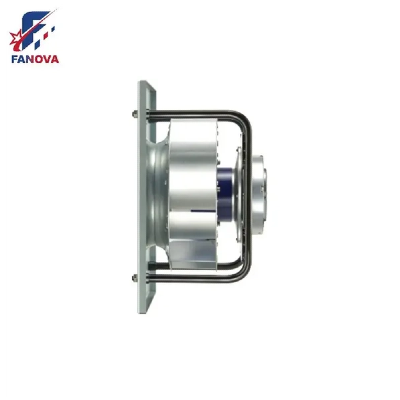
Fanova’s 48V DC 133mm 42W backward centrifugal bracket fan is designed for fast extraction of dust and harmful gases in compact industrial setups, combining structural support and pressure capability.
Dust composition influences material choice. Abrasive dust requires hardened surfaces. Corrosive dust demands coated or stainless-steel components. Selecting appropriate materials extends equipment life and reduces maintenance cost.
Dust is not merely a performance concern; it represents a potential hazard.
Fine organic dust, grain dust, and certain metal powders can become explosive when suspended in air under ignition conditions. Dust accumulation within ducts or fan housings increases risk.
Spark-resistant fan designs minimize metal-to-metal contact. Grounding prevents static charge buildup. Proper airflow management reduces localized overheating.
Regular cleaning of fan housings and ductwork prevents dust accumulation. Monitoring vibration levels detects imbalance before blade contact occurs. Maintaining proper alignment reduces friction-related heat generation.
Safety-focused design combined with disciplined maintenance ensures long-term operational security.
Even the best centrifugal fan will underperform if installation quality is poor.
Air entering the fan should be uniform and swirl-free. Installing elbows directly at the inlet creates uneven blade loading and reduces efficiency. Providing straight duct length before the inlet stabilizes airflow.
Air leakage reduces effective airflow while the fan continues consuming power. Sealing duct joints and ensuring proper flange connections maintain system efficiency.
Structural rigidity directly affects vibration behavior. Bracket-supported centrifugal fans provide stable mounting geometry, reducing oscillation risk. Fanova’s bracket designs enhance alignment accuracy and improve long-term durability in dust extraction applications.
Maintenance discipline ensures stable dust collection performance.
Inspect impeller blades for dust buildup. Check filter pressure differential. Examine bearings for abnormal temperature. Verify bolt torque and bracket stability.
Establish vibration thresholds that trigger inspection. Waiting until visible imbalance occurs increases mechanical wear. Scheduled cleaning prevents progressive efficiency loss.
Maintain logs documenting airflow, pressure drop, and vibration measurements. Historical data helps predict maintenance needs and prevents sudden performance failure.
Dust collection systems often run continuously during production shifts. Energy efficiency therefore impacts operating cost significantly.
Higher static pressure demands increase required air power. Selecting a centrifugal fan operating near its optimal efficiency region reduces energy waste.
Variable speed control allows operators to maintain airflow despite moderate filter loading without excessive energy use. Adjusting speed prevents unnecessary power consumption when demand decreases.
Category | What to Specify | Why It Matters |
Dust Type | Wood, metal, pharma, particle size | Determines blade durability |
Airflow Target | Capture velocity and airflow | Defines required fan capacity |
Total Static Pressure | Include all system losses | Prevents underpowered selection |
Safety Requirements | Combustible dust concerns | Ensures compliance |
Maintenance Access | Cleaning intervals and inspection | Reduces downtime |
Providing this information ensures accurate centrifugal fan matching and long-term reliability.
When dust collection systems are improperly specified, facilities experience declining capture efficiency, increased housekeeping cost, and potential regulatory issues. Proper centrifugal fan selection prevents such decline.
Stable pressure management, curve-based performance evaluation, and maintenance discipline ensure that the dust collection fan performs consistently year after year.
A dust collection system performs only as well as the fan driving it. Static pressure management, filter loading behavior, installation quality, and structural stability all determine long-term effectiveness. Selecting a high-quality centrifugal fan capable of handling full system resistance, maintaining airflow under loading conditions, and operating safely within its performance curve ensures reliable dust capture and reduced downtime. For facilities seeking high-performance extraction solutions, contact Fanova (Suzhou) Motor Technology Co., Ltd. to discuss system requirements and identify the most suitable industrial air handling solution for your operation.
Because maintaining capture velocity requires overcoming total system resistance, which increases as filters load.
Airflow decreases, reducing dust capture efficiency and potentially allowing airborne particles to escape.
They generally offer better pressure stability and efficiency under medium-to-high resistance conditions.
Inspection frequency depends on dust type and system load, but regular monitoring of pressure and vibration prevents unexpected failures.


