
Views: 0 Author: Site Editor Publish Time: 2026-06-25 Origin: Site


Industrial drying demands immense energy. Removing moisture efficiently dictates both production cycle speed and overall facility margins. When air fails to penetrate dense materials, uneven drying plagues your final output. Engineers rely on the Industrial Drying Fan to solve this exact problem. These robust machines act as the primary drivers of airflow, pushing through high system resistance where standard fans stall.
This guide provides a clear framework for evaluating and specifying these critical components. You will learn to size equipment accurately without over-specifying or risking costly operational downtime. We will explore impeller dynamics, thermal density corrections, and modern efficiency upgrades. You can then integrate these insights directly into your next system overhaul.
High-Pressure Capabilities: Centrifugal fans are required in drying systems to push forced air through dense materials and complex oven geometries where axial fans fail.
System Sizing Nuances: Accurate specification requires calculating air density corrections for high-temperature and high-altitude operating conditions.
Efficiency Upgrades: Transitioning to backward-curved impellers and high-efficiency motors with VFDs can reduce drying system energy consumption by 20–30%.
Implementation Realities: Proper clearance tolerances, bearing selection, and correct motor wiring are critical to avoiding hidden efficiency losses.
Drying operations face severe aerodynamic challenges. Dense product beds, thick filters, and complex ductwork create immense resistance. A standard axial fan simply cannot overcome this pressure drop. Engineers default to the centrifugal blower because it generates superior static pressure. When air enters the impeller eye, centrifugal force accelerates it outward. The subsequent 90-degree airflow deflection transforms kinetic energy into raw pushing power. This forces air through tightly packed materials.
Industrial drying relies on two distinct aerodynamic functions. You must balance them perfectly to optimize energy usage.
Exhaust and Moisture Extraction: The system must rapidly vent moisture-laden air. If humid air lingers, you risk localized overheating or uneven product curing. Fast extraction keeps the drying environment highly receptive to evaporation.
Thermal Recirculation: Venting all heated air wastes massive amounts of energy. The system reroutes residual hot air back to the inlet. This hot air circulation drastically reduces the load on industrial heaters.
You also need stable pressure for reliable process ventilation. The fan housing, known as the volute scroll, plays a crucial role here. High-velocity air leaves the impeller blades and enters the expanding scroll. The housing slows this air down safely. This deceleration converts velocity pressure into stable static pressure. You get a consistent, powerful airstream ready to penetrate the drying chamber.
The impeller represents the heart of your drying system. Selecting the wrong blade profile guarantees poor performance and high maintenance bills. We evaluate three primary designs for drying applications.
Backward-curved or backward-inclined impellers dominate modern drying facilities. They stand as the industry standard for clean to moderately dusty environments. These blades slope away from the direction of rotation. This geometry offers the highest mechanical efficiency available. It also features a non-overloading power curve. If system pressure drops suddenly, the motor will not draw excessive current and burn out. They are perfect for continuous hot air loops.
Radial or straight-blade impellers prioritize rugged durability over peak efficiency. We specify them when the drying process involves heavy particulate suspension. Flash dryers processing powders or pneumatic conveying lines require this design. Straight blades resist dust buildup and withstand abrasive impacts. You sacrifice some aerodynamic efficiency to prevent catastrophic imbalance.
Forward-curved impellers see very limited use in heavy industrial drying. Their blades cup the air, creating high volumes at lower speeds. While quiet and compact, they suffer from lower mechanical efficiency. They also trap dust easily. Engineers generally avoid them unless designing highly compact, clean HVAC-style drying configurations.
Impeller Type | Primary Application | Efficiency Level | Particulate Tolerance |
|---|---|---|---|
Backward-Curved | General industrial drying, clean hot air loops | High (75% - 85%) | Low to Moderate |
Radial / Straight-Blade | Flash drying, pneumatic material conveying | Medium (55% - 65%) | High (Self-cleaning) |
Forward-Curved | Compact, ultra-clean commercial drying units | Low to Medium | Very Low |
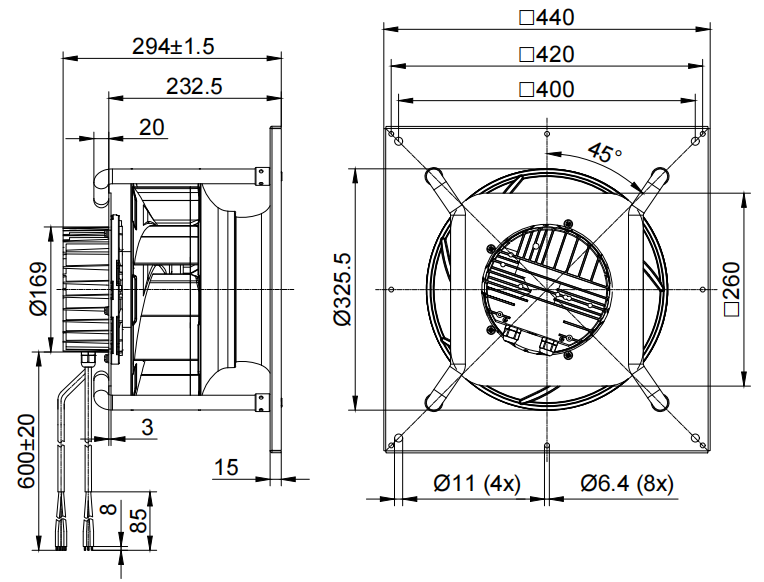
Procuring a reliable drying process fan requires strict attention to operating environments. Standard catalog ratings often mislead inexperienced buyers. Manufacturers base base performance curves on standard air conditions. This assumes an air temperature of 70°F at sea level.
Air density and temperature correction represents a crucial engineering reality. An industrial oven fan operates at severely elevated temperatures. Hot air expands and becomes significantly less dense. If you dry materials at 200°F or higher, the fan moves lighter air. It will generate less static pressure and draw less horsepower than standard charts indicate. Buyers must apply specific density correction factors. You multiply your target pressure by this factor to find the true required rating. Failing to correct for density leaves you with vastly undersized equipment.
Material and construction standards dictate equipment lifespan. Extreme heat causes metal to expand. Engineers must evaluate housing and impeller materials for specific thermal expansion thresholds. If you process acidic or chemical-laden materials, standard carbon steel will fail rapidly. You should specify stainless steel or specialized corrosive-resistant alloys. You must also select the right drive mechanism:
Direct Drive: The motor connects directly to the impeller wheel. This setup features fewer moving parts, requiring minimal maintenance. It offers higher efficiency since you lose no power to belt friction. However, you cannot change speeds easily without a VFD.
Belt Drive: Pulleys and belts connect the motor to the fan shaft. This offers RPM flexibility. You can alter fan speed simply by changing pulley sizes. However, belts stretch and wear out. They require strict maintenance protocols to prevent slippage and hidden energy losses.
Modernization shifts focus from brute force to intelligent control. Upgrading legacy systems yields massive reductions in energy consumption. The transition begins at the motor and extends to real-time analytics.
High-efficiency motors paired with Variable Frequency Drives (VFDs) change the game entirely. Historically, operators used physical dampers or guide vanes to throttle airflow. This method wastes energy because the motor continues running at full speed against a blocked pipe. VFDs enable automated, non-linear speed control. The drive slows the motor down directly based on real-time moisture levels. Dropping fan speed by just 10% can reduce energy usage by nearly 30% due to the affinity laws of centrifugal dynamics.
Intelligent sensor integration moves facilities from preventative to predictive maintenance. You mount vibration, temperature, and humidity sensors directly onto the equipment framework. These sensors monitor bearing health and aerodynamic stability in real time. If dust accumulates unevenly on a blade, vibration spikes slightly. The system alerts technicians before a catastrophic failure occurs. This ensures the equipment operates continuously at peak efficiency.
We always recommend demanding AMCA compliance. The Air Movement and Control Association sets strict testing standards. Procuring equipment based strictly on AMCA-certified ratings guarantees promised performance metrics. Uncertified fans often fall short of their published airflow numbers, crippling your drying times.
Chart: Energy Reduction Strategies in Drying Systems | ||
Efficiency Strategy | Implementation Method | Expected System Impact |
|---|---|---|
Variable Frequency Drives | Replace physical dampers with VFD motor control | 20–30% reduction in electrical energy usage |
Predictive Sensors | Install vibration and heat monitoring on bearings | Prevents catastrophic failure and unplanned downtime |
Aerodynamic Upgrades | Retrofit forward-curved blades to backward-inclined | Improves mechanical efficiency by up to 15% |
Even perfectly specified equipment fails if improperly installed or poorly maintained. Field engineers encounter several recurring traps during commissioning and routine operation.
The "reverse wiring" trap ranks among the most common installation errors. Technicians sometimes wire a 3-phase motor backward. Curiously, a centrifugal impeller will still blow air out the exhaust if running in reverse. The volute housing dictates the ultimate airflow direction. However, the fan operates at a severely reduced capacity. It generates a fraction of its intended static pressure while consuming excessive power. Maintenance teams often overlook this, assuming the system merely lacks capacity. Always double-check rotational arrows during initial startup.
Clearance tolerances demand strict manufacturing precision. Aerodynamic efficiency relies on a tight seal between the rotating impeller tip and the stationary housing inlet cone. Optimal clearance usually measures around 0.25% of the wheel diameter. If this gap widens, high-pressure air leaks back into the low-pressure inlet. Loss of this tolerance destroys static efficiency. Thermal warping frequently causes this issue in high-temperature ovens. If components expand unevenly, the gap widens permanently.
Bearing degradation poses a constant threat in high-heat applications. Standard bearings fail quickly when exposed to oven temperatures. The heat conducts down the fan shaft directly into the bearing grease, cooking it solid. You must evaluate thermal isolation strategies. Heat-slingers (small cooling wheels mounted on the shaft) dissipate heat before it reaches the bearings. Water-cooled bearing housings offer extreme protection for continuous industrial loads. Some advanced facilities even utilize magnetic bearings to isolate the drive entirely from the heat source.
Selecting the ideal industrial fan requires a careful balance. You must weigh aerodynamic efficiency against thermal resilience and particulate loads. Backward-curved impellers provide excellent baseline performance, but unique environments may demand rugged radial alternatives. Integrating smart controls and applying strict density corrections separates adequate setups from highly optimized operations.
Take action before requesting your next manufacturer quote. Audit your current oven static pressure drops thoroughly. Measure the actual operating temperatures at the fan inlet. Armed with accurate data, you ensure custom sizing matches your reality, safeguarding your production cycles against costly bottlenecks.
A: Engineering standards define them by their specific pressure ratio (discharge pressure divided by suction pressure). Fans operate at a ratio of 1.11 or lower. Blowers push harder, operating between 1.11 and 1.20. Compressors handle extreme resistance, generating pressure ratios greater than 1.20. Most standard drying applications utilize fans or low-range blowers.
A: Several hidden issues cause this drop. A 3-phase motor wired in reverse still blows air, but at a vastly reduced volume. Blocked intake filters also choke the supply. Additionally, intense thermal expansion can warp internal components, widening the clearance between the blades and the housing, which ruins static efficiency.
A: No. Standard models fail rapidly in elevated temperatures. Their standard bearings cannot withstand the heat traveling down the shaft. Standard housings warp, destroying internal aerodynamic clearances. Furthermore, hot air is less dense. Without recalculating density correction factors, a standard fan motor and impeller will be severely undersized.


