
Views: 0 Author: Site Editor Publish Time: 2026-06-10 Origin: Site


Cooling operations routinely devour up to 40% of total data center energy consumption today. As modern rack power densities frequently push past the 20 kW threshold, legacy room-chilling methods simply no longer make financial or operational sense. Facility managers face immense pressure to keep equipment cool without letting electricity bills skyrocket. We are currently witnessing a massive shift from brute-force room cooling to precision-engineered thermal management. This modern approach relies heavily on advanced aerodynamic designs and intelligent motor controls rather than pushing cold air blindly. The goal of this article is to provide a clear technical framework for evaluating and deploying the right Industrial Fan technologies. You will learn how to properly match airflow geometry to your specific facility layout. Ultimately, you can significantly reduce your Power Usage Effectiveness (PUE) while comprehensively safeguarding critical system uptime.
Increasing fan speed or adding units does not inherently solve cooling issues; true efficiency requires pressure-balanced airflow containment.
Replacing legacy AC motors with electronically commutated (EC) fans can yield immediate operational cost savings of up to 50–70% through optimized partial-load performance.
Selecting between centrifugal and axial designs depends strictly on the application environment, such as CRAH units versus server rack integration.
Mission-critical deployments must prioritize resonance detection, harmonic mitigation (Active PFC), and predictive bearing failure analytics.
Modernizing a facility begins with understanding the core architecture moving the air. You cannot optimize airflow without first mapping how your base infrastructure generates and distributes cooling. The industry primarily categorizes these macro-level systems into two distinct cooling deployments.
Computer Room Air Conditioning (CRAC) and Computer Room Air Handlers (CRAH) function differently despite achieving similar goals. CRAC units utilize mechanical compressors and direct expansion refrigerant cycles to cool the air. They work well for smaller, legacy server rooms. In contrast, CRAH units connect to a centralized chilled water plant. They circulate chilled water through cooling coils.
Both systems rely heavily on massive blower arrays. Facility engineers integrate a large ventilation fan within these units to push conditioned air either through pressurized raised floors or via overhead ducting. The efficiency of the entire room heavily depends on how well these fans overcome the static pressure of the facility layout.
High-density environments generating 18–20 kW per rack demand a radically different approach. Pushing air across a 100-foot room wastes tremendous energy. Engineers now bring the cooling directly to the heat source.
Row Cooling: Facilities place slim cooling units directly between server racks. This shortens the airflow path and prevents hot and cold air mixing.
Fan Walls: Massive data centers utilize clustered fan walls. These are grid arrays of multiple smaller fans rather than one giant blower.
Fan walls provide modular, scalable airflow. If one fan module fails, the intelligent system immediately compensates by slightly increasing the speed of adjacent units. This guarantees highly redundant airflow distribution for critical operations.
Leveraging ambient outdoor temperatures drastically slashes energy costs. If a facility operates in a suitable climate, engineers implement free cooling strategies. They use robust industrial exhaust and supply fans to draw in cool outside air. This technique significantly reduces reliance on power-hungry mechanical chillers. Effective data center cooling systems automatically switch between mechanical chilling and free cooling based on real-time ambient temperature sensors, maximizing efficiency year-round.
When thermal hotspots emerge on the server floor, the immediate reaction is often to crank up fan speeds or add more cooling units. This brute-force tactic almost always fails. It ignores the fundamental physics of fluid dynamics.
Procurement teams frequently buy fans based solely on the manufacturer's maximum CFM (Cubic Feet per Minute) rating. You must realize these ratings are established under Normal Temperature and Pressure (NTP) in perfect lab conditions. Real-world air density, drastic temperature gradients, and localized pressure drops radically alter actual performance. A fan rated for 5,000 CFM in an open room might only push 2,500 CFM when fighting the back pressure of dirty filters and packed cable trays.
A common engineering mistake involves forcing ultra-high-velocity air beneath a raised floor. Facility managers assume faster air means cooler servers. The Bernoulli Principle dictates otherwise. When air moves too fast under the floor tiles, it actually creates localized negative pressure zones.
Instead of pushing cold air up through the perforated floor grates, the high-speed air stream creates a vacuum effect. It pulls ambient room air down into the floor. This completely starves your high-density racks of the cold air they desperately need.
The true solution lies in Hot/Cold Aisle Containment paired with adaptive airflow control. Physical barriers must separate the cold supply air from the hot exhaust air. Once you isolate the air streams, you aim for a "zero-pressure" balance.
Monitor rack intake: Measure exactly how much air the IT equipment draws in.
Match exhaust rates: Adjust facility fan speeds to match the server intake rate perfectly.
Eliminate bypass: Prevent excess cold air from bypassing the servers and returning to the AC unit unused.
Matching flow rates perfectly eliminates thermal hotspots and prevents overcooling, ensuring energy is only spent moving the exact volume of air required.
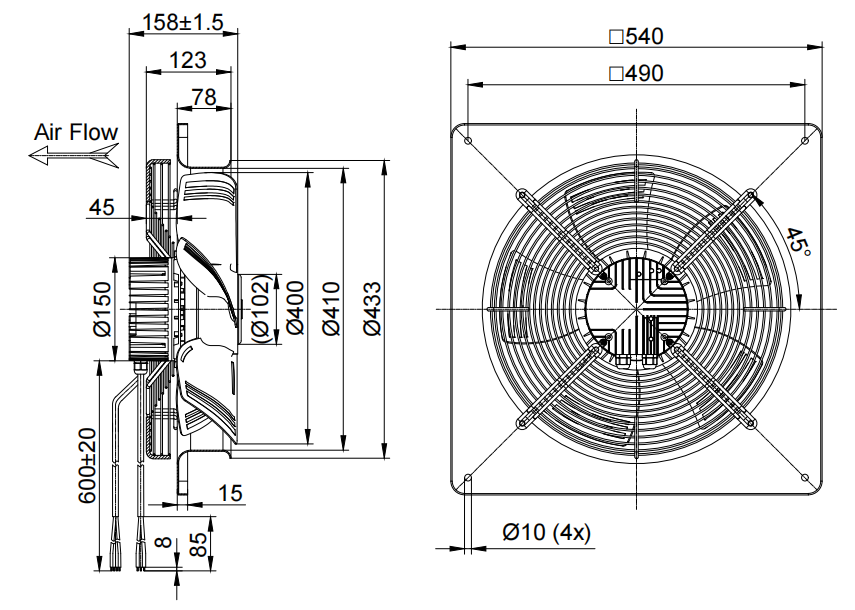
Choosing the wrong fan geometry guarantees poor performance and inflated energy bills. Fans move air in entirely different ways depending on their blade design. You must align the fan's aerodynamic profile with the physical constraints of the installation.
Feature | Axial Fans | Centrifugal Fans |
|---|---|---|
Airflow Path | Straight through (parallel to the shaft) | Radial (90-degree turn from inlet to outlet) |
Primary Strength | High volume at low to moderate pressure | High static pressure capability |
Ideal Placement | Server racks, exterior condensers | CRAH units, AHUs, underfloor plenums |
Efficiency Focus | Blade profile optimization | Impeller outflow management |
Axial fans pull air parallel to the rotating shaft. They excel at moving massive volumes of air against relatively moderate resistance. This makes them the perfect choice when specifying a server cooling fan embedded directly into the IT rack. They also dominate external heat rejection roles, such as spinning inside rooftop chiller condensers.
Modern data centers face intense scrutiny regarding noise pollution, especially in urban areas. Engineers now utilize biomimetic blade designs inspired by nature. Serrated trailing edges and swept blade shapes allow these fans to handle moderate back pressure silently. This structural innovation cuts down tonal noise without sacrificing aerodynamic efficiency.
Centrifugal units pull air into the center of an impeller and fling it outward at a 90-degree angle. This radial flow generates tremendous static pressure. They are the undeniable champions for CRAH and AHU units. In these systems, air must be aggressively pulled through thick HEPA filters, pushed across dense cooling coils, and forced through complex underfloor plenums.
Recent engineering advances focus heavily on impeller outflow optimization. By refining how air exits the scroll housing, designers significantly reduce deflection turbulence and exit losses. As a result, the fan hits its required operational set-point at a much lower, highly energy-efficient motor speed.
Motor technology dictates your facility's base electrical load. Relying on outdated motor infrastructure bleeds capital month after month. Upgrading your drive systems offers the fastest return on investment in facility modernization.
Traditional AC induction motors have severe operational limitations. They generally require Variable Frequency Drives (VFDs) to modulate speed. Unfortunately, AC motor efficiency drops off a cliff the moment you operate them outside their peak load curves. They consume excessive power just to maintain their internal magnetic fields at lower speeds. Older DC motors present different headaches. They rely on mechanical carbon brushes to operate. These brushes wear out constantly, shed conductive dust into the environment, and drastically limit the unit's lifespan.
An electronically commutated (EC) motor combines the best of both worlds. The technology integrates internal AC-to-DC rectification with advanced brushless operation. The onboard electronics convert the facility's incoming AC power into DC voltage internally. A microprocessor then controls the magnetic fields to spin the rotor with absolute precision.
Choosing an EC fan yields massive efficiency gains. They maintain up to 70% better electrical efficiency at partial speeds compared to legacy AC drives. When you multiply this fractional savings across hundreds of fan units running 24/7, the exponential energy savings become staggering.
Facility managers often fear that upgrading to EC technology requires ripping out the entire electrical infrastructure. This is a myth. EC systems offer seamless drop-in replacement feasibility. Because the AC-to-DC conversion happens inside the motor housing itself, they connect directly to your existing AC power grid. You avoid costly rewiring and keep retrofit downtime to an absolute minimum.
Operating thousands of electronically controlled motors can introduce harmful electrical noise back into the facility's power grid. Modern units solve this through Active Power Factor Correction (PFC). This integrated electronics layer ensures the motor draws power in perfect phase with the grid voltage. Keeping Total Harmonic Distortion (THD) below 2% prevents massive reactive power losses. It essentially protects the data center's electrical backbone from unnecessary strain and heat.
In a mission-critical environment, a fan failure is not just an inconvenience; it triggers thermal runaway. You must specify hardware equipped with built-in intelligence and stringent safety compliance.
Every mechanical system has natural resonant frequencies. If a motor operates at these specific RPMs, the resulting vibrations will quickly destroy the sealed bearings. Advanced systems now feature automated resonance detection. During the initial commissioning phase, the controller sweeps through the entire RPM range to identify high-vibration zones. The software then programs the motor to automatically "skip" these critical ranges during normal operation. This preventative measure eliminates catastrophic bearing degradation.
Uptime guarantees require N+1 redundancy woven into the physical airflow. You must construct dual-path airflow designs. If a single blower faults out, the system cannot wait for human intervention. Intelligent controllers—communicating via 0-10V analog, PWM, or RS485 digital protocols—must detect the pressure drop instantly. They autonomously ramp up the adjacent units in the fan wall. This immediate response maintains the required Delta-T (typically ensuring the difference between supply and return air remains >10°C) across the IT equipment.
Environmental regulations are pushing the industry toward natural, eco-friendly refrigerants like propane (R290). While highly efficient, these refrigerants are flammable. You must strictly adhere to compliance standards such as EN 60335-2-40. This regulation ensures the motor's electronic surface temperatures remain safely below the refrigerant's specific ignition threshold. Even in the event of a catastrophic electrical fault, the fan components will not become a viable ignition source.
An industrial fan is never a static commodity. It acts as a dynamic, highly critical component within your facility's overarching thermal management strategy. Sticking to outdated airflow paradigms directly harms operational viability and inflates energy bills unnecessarily.
Facility and procurement managers should immediately initiate a comprehensive CFD (Computational Fluid Dynamics) audit. This diagnostic step identifies exact locations of bypass air and thermal pooling. Following the audit, calculate the immediate ROI of an EC motor retrofit based on your localized kW/h electricity costs. You will likely find the payback period is remarkably short.
Do not attempt a massive overhaul blindly. We highly recommend consulting with specialized airflow engineers. They will help you map out a phased, non-disruptive upgrade path that securely aligns with your current PUE targets and redundancy requirements.
A: Yes. Modern EC fans feature built-in AC-to-DC rectification. They accept standard alternating current directly from your existing facility grid. This drop-in compatibility eliminates the need to install new electrical panels or run fresh DC wiring, making retrofits remarkably fast and cost-effective.
A: Focus strictly on objective hardware metrics. Look for abnormal acoustic profiles, sudden unexplained power consumption spikes, and measurable bearing temperature increases. Automated building management systems should track these specific parameters to alert maintenance teams long before mechanical seizure occurs.
A: Continuous-duty applications demand maintenance-free longevity. Sealed ball bearings come pre-lubricated for life. The robust sealing protects the internal rolling elements from microscopic dust accumulation and moisture, which are the primary causes of friction and eventual mechanical failure in server rooms.
A: Modern fans integrate seamlessly via standardized control inputs. Facilities commonly use RS485/Modbus for deep digital telemetry, PWM (Pulse Width Modulation) for precise digital speed increments, and 0-10V analog signals for straightforward voltage-based RPM control. This allows the BMS to dynamically adjust airflow based on real-time heat loads.


