
Views: 0 Author: Site Editor Publish Time: 2026-06-14 Origin: Site


A High Pressure Centrifugal Fan is the mechanical heart of any industrial air filtration system. Choosing the wrong fan causes inadequate capture velocities across your facility. This specific failure risks severe OSHA and NFPA violations. Over-engineered systems, conversely, waste thousands of dollars in annual energy costs. Unlike standard HVAC ventilation, industrial dust collection presents a unique engineering challenge. You must overcome significant and rapidly fluctuating static pressure. This fluctuation happens constantly as filter media loads heavily with particulates.
This guide provides facility engineers and procurement managers an evidence-based framework. You will learn how to evaluate, size, and select the correct fan for your needs. We base this methodology on actual operating conditions rather than baseline specifications. You will discover exactly how to balance aerodynamic efficiency targets against rugged durability requirements. We will explore airflow velocity, pressure resistance, and essential compliance standards.
Calculate for worst-case resistance: Always size the fan for the "loaded-filter" static pressure (typically 8–12 in. WG), not the clean-filter baseline.
Match impeller design to airstream: Efficiency is secondary to durability if handling abrasive materials. Putting an ultra-efficient airfoil fan in a dirty airstream will destroy the hollow blades.
Placement dictates lifespan: Installing the fan on the "clean side" (draw-through configuration) can extend bearing and impeller lifespan by 3x to 5x compared to dirty-side placement.
Control methodology matters: Pairing the fan with a Variable Frequency Drive (VFD) rather than manual dampers ensures consistent airflow while capturing significant energy savings as filter resistance fluctuates.
Volumetric airflow dictates your baseline performance. We measure this airflow in Cubic Feet per Minute (CFM). You establish CFM requirements based on hood design and your total facility footprint. Moving air is only half the battle. Maintaining proper transport velocity remains absolutely critical. Heavy materials like wood shavings or metal dust require high speeds. You need a sustained 3,500–4,500 Feet Per Minute (FPM) to move them safely.
If duct velocity drops below this threshold, suspended material settles quickly. Particulates accumulate inside your ductwork over time. This creates severe fire hazards and reduces system efficiency. Proper fan sizing guarantees you maintain this minimum velocity across the longest duct runs.
Static pressure measures total system resistance. Engineers typically measure this resistance in inches of water gauge (in. WG). It includes duct friction, tight elbows, capture hoods, and the collector unit itself. You must push air through all these obstacles continuously. Many buyers calculate static pressure using perfectly clean filters. This approach guarantees eventual system failure.
Pro Tip: The "Loaded-Filter" Trap
A brand new filter may only drop 3–5 in. WG. However, pre-pulse loaded filters will inevitably spike to 8–12 in. WG during operation. Fans sized strictly for clean filters will stall under actual operational loads. Always design your system for worst-case resistance.
Fan volume must sync perfectly with your filter media. We call this the air-to-cloth ratio. You calculate it by dividing total airflow by the total filter area of your dust removal equipment. High air-to-cloth ratios force dust deep into the filter fabric. This causes premature filter blinding and drastically shortens filter lifespan. A properly sized fan prevents this aggressive particulate embedding. It protects your consumable filters from rapid degradation.
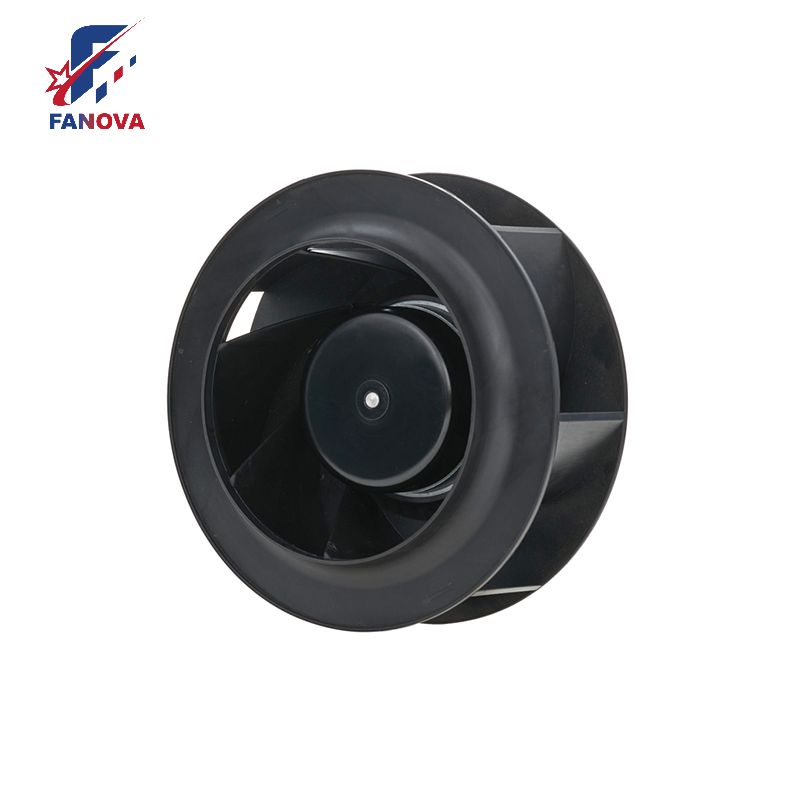
Impeller selection defines how your system performs under stress. Different blade shapes handle particulate loads very differently. We must balance aerodynamic efficiency against mechanical durability.
Fan Type | Average Efficiency | Best Application | Durability Level |
|---|---|---|---|
Radial Blade | 60% - 65% | Abrasive dust, heavy material handling | Very High |
Backward Inclined | 70% - 80% | Standard dust collection, clean air | Medium-High |
Airfoil | Up to 90% | Strictly clean-side exhaust only | Low (Vulnerable) |
These units typically operate at 60–65% efficiency. They feature flat, paddle-like blades radiating straight out from the hub. This design makes an excellent industrial exhaust fan for brutal environments. A rugged radial fan handles heavy abrasive materials exceptionally well. It thrives in "dirty-side" installations. The flat blades are naturally self-cleaning. They prevent fibrous material or wet dust from building up and unbalancing the wheel.
Backward inclined fans offer 70–80% efficiency. They are ideal for standard collection setups. You use them when the airstream is lightly dusty or mostly clean. Their blades lean away from the direction of rotation. This geometry creates a non-overloading horsepower curve. If your system pressure drops suddenly, the motor will not draw excess current. This inherent protection prevents costly motor burnouts during unpredictable pressure shifts.
Airfoil fans achieve up to 90% efficiency. They run exceptionally quietly compared to other designs. The blades resemble hollow airplane wings. You must only use them on the clean side of an air filtration system. Even mild particulate will abrade the thin metal skins quickly. Dust breaches the hollow interior and accumulates unevenly. This unbalances the wheel rapidly, leading to catastrophic vibration and bearing failure.
Where you place the fan determines its maintenance schedule and operational lifespan. The two primary configurations offer distinct trade-offs.
Clean-Side (Draw-Through): You place the fan after the filter media. The fan only handles clean, filtered air. This setup allows you to utilize highly efficient airfoil impellers safely. Clean-side placement extends overall lifespan by 3 to 5 times. Bearing maintenance cycles easily stretch to 24–36 months under continuous use.
Dirty-Side (Blow-Through): The fan handles raw, unfiltered dust directly from the ductwork. You push dirty air into the collector. This requires extremely rugged radial fans. Engineers often specify AR400 hardened steel for the impellers. The severe abrasion shrinks maintenance cycles down to 8–14 months.
Transmission choices impact your footprint and long-term energy usage.
Direct drive configurations offer a compact footprint. The impeller mounts directly onto the motor shaft. They require significantly lower maintenance because there are no belts to tension or replace. You experience virtually zero transmission power loss. Motor energy transfers directly to air movement.
Belt drive systems allow for precise speed adjustments. You simply change the sheave sizes to dial in exact performance. Belts also isolate the motor from wheel vibration effectively.
⚠️ Warning: The 5% Rule
Belt drives inherently suffer a 3–5% friction energy loss. Over a year of continuous 24/7 operation, this friction loss compounds rapidly. It easily translates to hundreds of dollars in wasted electricity compared to highly efficient direct-drive setups.
Handling explosive materials introduces serious safety liabilities. Combustible dust requires specific explosion-proof or spark-resistant construction. You must evaluate your material against AMCA Type A, B, or C spark resistance standards. Type A uses entirely non-ferrous construction. Type B features a non-ferrous wheel. Type C relies on a non-ferrous buffer ring to prevent steel-on-steel contact. Proper duct grounding is equally critical to prevent static discharge. Failure to comply with NFPA guidelines results in severe OSHA penalties.
Industrial safety standards strictly cap 8-hour noise exposure at 90 dBA. Powerful high-pressure fans easily exceed this limit without proper mitigation. You should target a fan design and enclosure strategy that operates at or below 85 dBA. We achieve this by adding acoustic silencers to the exhaust stack. Sound-attenuating enclosures around the fan casing also drop decibel levels significantly. Protecting your workforce from hearing damage is a non-negotiable engineering priority.
Facility managers often size fans exactly to their current operational limits. This represents a costly strategic mistake. We recommend selecting a fan whose Best Efficiency Point (BEP) accommodates growth. Aim for a design that allows a 15–20% capacity increase. This buffer accommodates future facility expansions smoothly. You can add extra ducting or new extraction points later. You will not need to authorize a full fan replacement when production scales up.
Selecting an industrial centrifugal blower is rarely a standard catalog purchase. Complex pneumatic systems demand nuanced engineering. You must overlay your unique system resistance curves onto the manufacturer's fan performance curves. The intersection of these two curves dictates your true operating point. A slight miscalculation here means your system either underperforms dramatically or consumes excessive power.
Choosing the right manufacturing partner is as critical as choosing the fan itself. Ask these questions during procurement:
Do they provide precise ROI calculations for VFD integration? A reliable vendor proves how quickly a Variable Frequency Drive pays for itself through energy savings.
Can they supply custom materials? Your application might require Fiberglass Reinforced Plastic (FRP) for corrosive chemical gases, stainless steel for food-grade lines, or AR400 plating for extreme abrasion.
Do they assist with optimizing aerodynamics? Expert vendors help design better inlet and outlet ducting. They suggest employing 15-degree converging sections. This minimizes turbulence and reduces costly pressure drops at the connections.
Sizing and selecting the correct centrifugal blower requires a disciplined engineering approach. You must constantly balance high efficiency targets against the harsh realities of pneumatic material handling. Misjudging your static pressure or selecting an overly delicate impeller leads to rapid equipment failure and compliance violations. Prioritize worst-case load scenarios over clean-filter baselines.
Your next step is clear. Audit your current facility's loaded static pressure profile carefully. Document the exact nature of your particulate load. Consult with specialized engineering vendors to run a customized Best Efficiency Point analysis. By mapping your precise resistance curves early, you guarantee a safe, compliant, and highly energy-efficient installation.
A: Axial fans function like propellers. They move high volumes of air but at very low pressure. A dust collection fan requires pulling dense air through extensive ductwork and restrictive filters. This application demands the high static pressure generation unique to centrifugal volute designs.
A: A VFD (Variable Frequency Drive) is vastly superior. It automatically adjusts fan speed to maintain constant airflow as filters become increasingly dirty. This intelligent control slashes energy consumption dramatically compared to choking an unrestricted fan with manual dampers.
A: The fan will fail to pull sufficient air. Capture velocity at the intake hood will drop well below the necessary 3,500 FPM. This causes dangerous, combustible dust buildup within your ducts. It results in immediate non-compliance with strict indoor air quality regulations.


