
Views: 0 Author: Site Editor Publish Time: 2026-06-02 Origin: Site


Upgrading facility ventilation requires careful consideration. You must balance initial capital expenditures against long-term operational efficiency. Strict industry compliance also plays a major role in your decision. Traditional AC fans once dominated the commercial market. However, modern building standards now demand much higher efficiency targets. Today, professionals evaluate hardware based on lifecycle energy reduction and seamless digital integration. We have moved far beyond basic airflow matching.
Specifying the wrong components leads to massive energy waste. It introduces unwanted noise. It also shortens equipment lifespans significantly. This guide provides facility managers, MEP engineers, and procurement teams with a reliable framework. You will learn how to properly specify the right hardware for your needs. We explain how to avoid frequent retrofit failures. By following these strict, vendor-neutral principles, you will optimize your facility airflow and ensure verifiable energy savings.
The "Safety Factor" Trap: Adding more than an 8% safety margin to static pressure calculations forces fans off their Best Efficiency Point (BEP), negating expected energy savings.
The 22kW Threshold: For applications under 22kW, an integrated EC motor fan dominates in TCO; above this, traditional AC + VFD setups may still compete on CAPEX.
Part-Load Dominance: Real-world HVAC systems rarely operate at 100% load. EC fans maintain 80–90% efficiency during partial load, significantly outperforming AC alternatives.
Avoidable Retrofit Failures: Overlooking control wire integration (resulting in 100% default speed) and ignoring Power Factor Correction (PFC) are the most common implementation errors.
Calculating precise static pressure is absolutely critical for system success. Engineers often overestimate system resistance to feel safe. This practice causes serious performance issues. Imagine your system requires 40mm of static pressure. If you apply an aggressive 30% safety factor, you size the system for 52mm. The EC Centrifugal Fan then supplies excessive airflow. It shifts far away from its Best Efficiency Point (BEP). Power consumption spikes dramatically. Keep any safety margins strictly under 8%. Precise calculations yield the best operational results.
You must also address part-load conditions during the design phase. Real-world systems rarely operate at maximum capacity. You should evaluate the performance curve at 60-80% speeds. Peak nominal data does not reflect daily reality. A true energy efficient fan maintains optimal power usage during off-peak hours. When the air handling unit scales down, energy usage must drop proportionally. Always request partial-load data from your suppliers. This ensures your system handles low-demand periods efficiently.
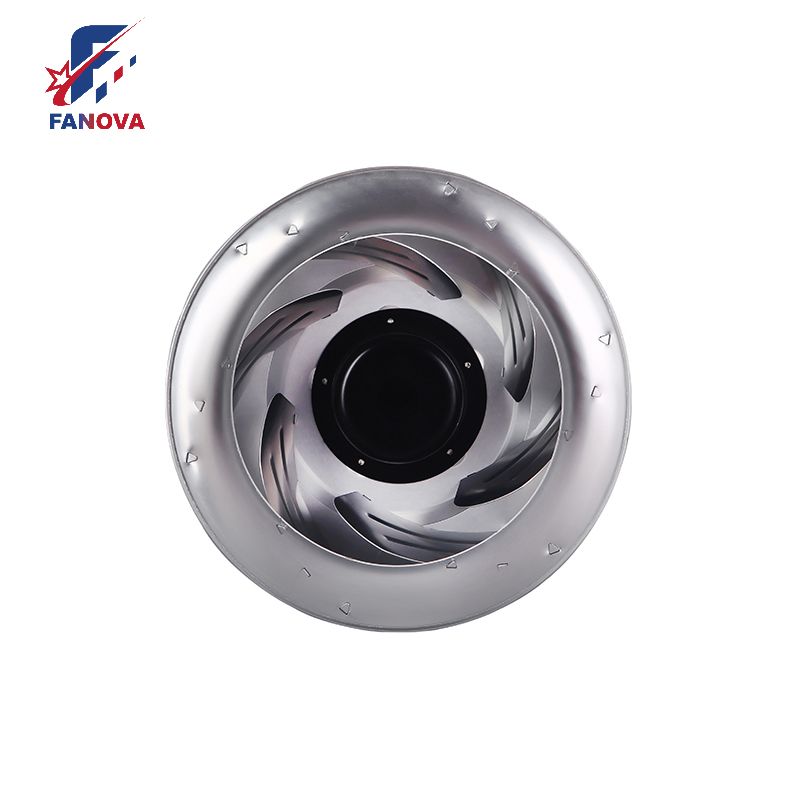
Modern ventilation units primarily use backward-curved impellers over traditional forward-curved designs. The aerodynamic benefits are substantial. Backward-curved designs convert velocity pressure directly into static pressure. This conversion happens right inside the blade channel. You no longer need bulky scroll housings. We often call these housings volutes. This direct pressure conversion prevents motor overloading. Forward-curved models trap dust easily and overload under high resistance. Backward-curved blades shed debris and maintain stable power curves.
External rotor architectures provide massive mechanical advantages. Traditional motors place the spinning rotor inside stationary coils. The external rotor reverses this design. The stator sits inside while the rotor spins around it. An EC motor fan utilizes this architecture highly effectively. The rotor connects directly to the impeller. This dramatically shrinks the installation footprint. The spinning fan creates continuous airflow over the internal coils. This self-cooling mechanism prevents heat buildup. Cooler operating temperatures significantly extend component lifespans.
Feature | Forward-Curved Impeller | Backward-Curved Impeller |
|---|---|---|
Housing Required | Yes (Bulky Volute) | No (Can operate as a plug fan) |
Power Curve | Overloading (Spikes at low resistance) | Non-overloading (Stable power usage) |
Dust Tolerance | Low (Blades trap particulates) | High (Self-cleaning geometry) |
Space Efficiency | Poor | Excellent |
Evaluating the capital expenditure (CAPEX) versus operational expenditure (OPEX) is vital. EC technology generally costs 20–40% more upfront. This premium pays for rare-earth magnets and integrated printed circuit boards. However, you easily offset this CAPEX during installation. You remove the need for external Variable Frequency Drives (VFDs). You also eliminate complex motor wiring and mechanical transmission parts. Belts and pulleys require constant tensioning and replacement. Removing them drops your ongoing maintenance costs to zero.
The 22kW threshold serves as a reliable industry heuristic. For ventilation equipment under 22kW, EC technology is the undisputed choice. It offers massive space savings and wiring simplicity. Payback periods often drop under one or two years. Applications exceeding 22kW enter ultra-heavy-duty industrial territory. Here, traditional AC motors paired with external VSDs might still compete on initial cost. You must perform a stricter side-by-side ROI calculation for these massive systems.
Acoustic performance represents another major advantage. Fan laws dictate clear rules about sound generation. Reducing speed even slightly drastically cuts noise. Traditional systems use physical dampers to restrict airflow while keeping motor speed high. This creates intense turbulence and loud whistling. Native 0-10V/PWM controllers reduce both airflow and rotational speed simultaneously. This smooth reduction inherently solves acoustic compliance issues.
Facility managers should follow a strict evaluation framework before finalizing specifications. This standardized process prevents costly operational misalignments. Use the following sequential steps to guide your next procurement cycle.
Step 1: Match Operating Point to BEP. You must ensure the target airflow and static pressure intersect correctly. They should land as close as possible to the maximum efficiency point on the performance curve. Drifting away from the BEP causes turbulence and energy waste.
Step 2: Verify Physical Footprint & Maintenance Space. Modular AHUs feature very tight internal spaces. You should specify unhoused plug fans for these constraints. They maximize internal plenum space. They also simplify localized maintenance procedures.
Step 3: Validate BMS Communication. Modern buildings rely on sophisticated control systems. Ensure the integrated electronics natively support required facility protocols. Check for direct Modbus or BACnet compatibility. Avoid setups requiring expensive third-party communication gateways.
Step 4: Demand Compliance Documentation. Never accept unverified vendor claims. Require AMCA-certified performance curves. Demand dynamic balance certificates from the supplier. Verify these documents before finalizing your HVAC fan specification.
Replacing legacy equipment introduces unique installation challenges. Field failures rarely stem from the hardware itself. They usually result from poor execution during the commissioning phase. Understanding these risks helps you protect your investment.
The "Default Full-Speed" Error: Installers frequently replace legacy hardware but fail to connect low-voltage control signals. Without a valid 0-10V or PWM signal, the unit defaults to 100% speed. This oversight completely destroys your intended energy efficiency goals.
Ignoring Power Factor Correction (PFC): Large fan arrays demand careful electrical planning. Failing to account for active PFC introduces severe harmonic distortion into the electrical grid. This distortion leads to nuisance tripping and premature breaker wear.
Suboptimal Mounting Execution: Contractors often reuse old rubber vibration pads to save time. These pads degrade and harden over the years. Specify new spring isolators for large upgrades. Match them to the precise weight and dynamic load of the new assembly.
Symptom | Probable Cause | Corrective Action |
|---|---|---|
Running continuously at 100% speed | Control wire disconnected or mismatched | Verify 0-10V/PWM signal continuity to BMS |
Excessive vibration on startup | Reused hardened rubber mounting pads | Install properly rated spring isolators |
Breakers tripping randomly | Harmonic distortion (No Active PFC) | Install harmonic filters or specify PFC units |
Airflow exceeds requirements | Aggressive safety factor applied to static pressure | Recalculate system resistance and reduce fan speed |
Choosing the correct ventilation hardware relies less on maximizing raw power. It relies entirely on precision-matching the optimal performance curve to your facility conditions. You must design for real-world, part-load realities rather than hypothetical peak scenarios. Eliminating aggressive safety factors ensures your equipment runs right at its best efficiency point. This disciplined approach guarantees stable airframes, lower acoustics, and significantly reduced power consumption.
Your next steps involve shortlisting highly transparent vendors. Demand comprehensive lifecycle savings calculators from them. Request verified dynamic balancing certificates before accepting delivery. Ask for an exact BEP analysis based on your specific system resistance. By strictly enforcing these parameters, you will successfully navigate the transition from legacy setups to modern, digitally integrated airflow systems.
A: No. The fundamental advantage of this technology is the integrated electronics. The inverter and controller are housed directly within the motor. This eliminates the need for an external VFD and expensive shielded cables.
A: High-quality units typically operate for 40,000 to 60,000 hours with near-zero mechanical maintenance. They achieve this by eliminating physical carbon brushes, belt friction, and rotor slip losses.
A: Standard units have temperature limitations due to onboard electronics. They usually cap around 60°C (140°F). For extreme high-temp or corrosive environments, you will need specialized housing, remote-mounted electronics, or traditional radial equipment.
A: This is almost always a control integration issue. If the 0-10V or PWM signal wire is disconnected or mismatched with the Building Management System (BMS), the fan defaults to maximum speed regardless of actual demand.


