
Views: 0 Author: Site Editor Publish Time: 2026-06-22 Origin: Site


Selecting an Industrial Ventilation Fan for waste gas extraction is never a basic equipment purchase. It stands as a critical decision dictating your facility’s legal compliance and daily reliability. Waste gas treatment setups, including modern scrubbers and thermal oxidizers, operate under extreme conditions. They constantly process corrosive chemical streams. They handle intense heat and abrasive particulate matter. These harsh variables quickly destroy standard commercial air movers. Therefore, facility managers must shift their perspective immediately. You cannot just buy a fan to solve an extraction problem. You must systematically evaluate highly specialized process fans tailored for brutal environments. This article guides you through the technical steps required to make an informed choice. We explore how to balance aerodynamic performance against rigid environmental regulations and ongoing maintenance needs. Read on to master the sizing, material selection, and engineering principles necessary for a truly robust extraction setup.
Application Dictates Design: Waste gas extraction requires "process ventilation" rather than "general ventilation," heavily favoring high-pressure centrifugal designs over standard axial models.
Sizing Realities: Oversizing wastes energy and capital; undersizing leads to non-compliance and hazardous gas buildup. Precise CFM and static pressure calculations are non-negotiable.
Material Durability: Handling corrosive or explosive gases necessitates specialized materials like FRP (Fiberglass Reinforced Plastic), customized protective coatings, or ATEX-certified components.
System Integration: Modern odor control systems and gas plants require fans to integrate seamlessly with pressure vessels, safety valves, and BMS (Building Management Systems).
TCO over Initial Purchase: Evaluation must prioritize Total Cost of Ownership (energy efficiency, maintenance intervals, downtime risks) over the upfront unit price.
We must first clearly understand the core engineering challenge. General ventilation moves clean, ambient air to cool people or regulate warehouse spaces. Process ventilation handles a much tougher, more dangerous job. It actively transports contaminated, highly resistant airstreams through complex industrial pipelines.
Systems executing waste gas treatment face immense system resistance. Engineers call this aerodynamic resistance static pressure. Your facility pushes or pulls dirty air through dense HEPA filters. The air navigates deep liquid beds inside wet scrubbers. It travels through elaborate, winding ductwork networks. Each single component powerfully resists the airflow. This creates a massive pressure drop across the entire treatment plant.
You might consider installing a standard industrial exhaust fan to save money. Do not make this critical mistake. Standard fans simply lack the structural integrity for harsh chemical environments. Deploying one here guarantees rapid impeller degradation. Motor overloads will trigger frequent, unpredictable system shutdowns. Ultimately, your facility risks severe EPA and OSHA compliance violations. Untreated toxic emissions will escape into the local atmosphere. You face heavy regulatory fines and potential facility closures if the extraction system fails. Process ventilation demands purpose-built machinery engineered specifically for high-stress applications.
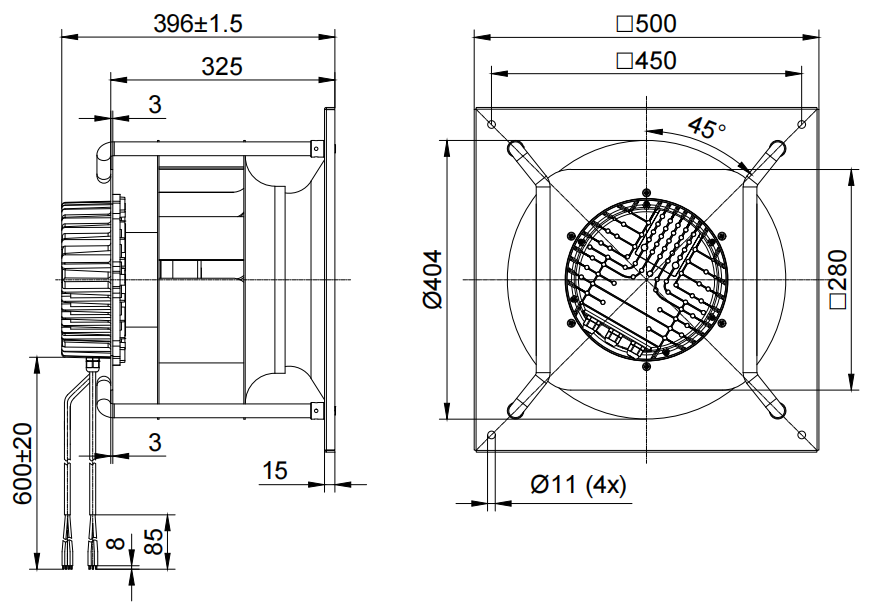
Which fan technology actually survives these brutal environmental conditions? We divide industrial fans into two primary categories. However, only one truly fits hazardous gas extraction scenarios.
Axial fans move massive volumes of air at very low pressures. They function similarly to airplane propellers. Some advanced vaneaxial fans can overcome up to 10 inches of water gauge (w.g.) static pressure. However, they remain highly unsuitable for heavy particulate loads. Corrosive waste gas streams quickly damage their internal mechanisms. Axial designs typically place the drive motor directly inside the parallel airflow. This vulnerable placement exposes critical electronic components to corrosive acids, extreme heat, and sticky dust. Maintenance becomes a nightmare when motors fail repeatedly in these conditions.
Engineers universally rely on the centrifugal fan for aggressive extraction tasks. They form the unbreakable backbone of every modern odor control system. A centrifugal unit pulls air into its central housing. It then forcefully expels the air at a 90-degree angle. This centrifugal mechanism spins the air outward. It generates massive kinetic force, allowing the system to easily overcome extreme static pressure.
Selecting the right blade profile dictates your long-term operational success. Different industrial contaminants demand specific blade structures to prevent blockages.
Radial Blades: These blades point straight out from the central hub. They are strictly designed for heavy dust and sticky particulates. The flat shape naturally resists material buildup. It practically cleans itself as it spins at high velocities.
Backward Inclined Blades: These blades lean away from the direction of rotation. They provide the absolute highest mechanical efficiency. Use them for the continuous-duty extraction of clean or mildly dusty chemical gases. They significantly reduce electrical consumption.
Forward Inclined Blades: These blades curve toward the rotation direction. Engineers generally avoid them entirely in waste gas facilities. They suffer severe performance drops when handling particulate-laden air and clog very easily.
Correct sizing prevents catastrophic mechanical failures. You must perfectly balance your required airflow volume against the internal system resistance.
Volume (CFM) and resistance share a strict inverse relationship. If system pressure rises, your airflow volume usually drops proportionally. Accurate measurement remains absolutely crucial. You must calculate the precise pressure drop across all wet scrubbers, ducting runs, and dampeners. Do this mandatory calculation before shortlisting any equipment. Guessing these aerodynamic numbers leads to immediate, costly system failure. A fan must generate enough force to push the exact required CFM through the worst-case resistance scenario.
Waste gas rarely enters the fan housing at room temperature. High-temperature exhaust streams significantly alter the physical air density. Hot air becomes much less dense than cold air. Standard factory fan performance curves always assume standard air density at 70 degrees Fahrenheit. Therefore, you must run specific mathematical derating calculations. You will likely need to adjust the motor horsepower and overall impeller sizing. This adjustment compensates for moving thinner, hotter air without burning out the motor.
Facilities often buy the wrong size out of panic or poor planning. Both sizing extremes carry serious operational penalties.
Undersized Equipment: A small fan fails to capture hazardous process emissions. Toxic gas actively builds up inside the enclosed workspace. This failure triggers heavy regulatory fines and actively endangers your workers' respiratory safety.
Oversized Equipment: Many plant engineers assume bigger is naturally better. An oversized fan actually causes severe aerodynamic surging. It vibrates violently within the ductwork. It accelerates mechanical wear on the bearings and heavily inflates your daily energy costs.
Table 1: Operational Impacts of Incorrect Fan Sizing | |||
Sizing Error | Aerodynamic Impact | Safety & Compliance Risk | Financial Consequence |
|---|---|---|---|
Undersized | Inadequate CFM, cannot overcome static pressure | Fugitive emissions, severe OSHA violations | Fines, forced shutdowns, lost production |
Oversized | Aerodynamic stall, flow surging, extreme vibration | Ductwork stress, accelerated bearing failure | Wasted energy, premature equipment replacement |
Reliable ventilation equipment must survive daily, brutal exposure to industrial acids. Volatile compounds destroy weak machinery. Standard materials will simply not last.
Standard carbon steel degrades rapidly when exposed to acidic waste gas. The metal rusts, flakes, and ultimately shatters under rotational stress. Specialized construction is entirely mandatory. Engineers heavily favor FRP (Fiberglass Reinforced Plastic) for environments containing concentrated sulfuric acid or chemical vapors. High-quality FRP completely resists most aggressive chemical attacks.
If structural rigidity remains paramount for high-pressure systems, stainless steel alloys become necessary. You can also apply specialized industrial epoxy or heavy-duty PTFE coatings to metallic impellers. These chemical coatings provide a vital extra layer of surface resistance against abrasive particles.
Personnel safety remains the top priority in any hazardous industrial environment. Combustible dust and volatile organic compounds (VOCs) create severe, invisible explosion risks.
ATEX and Explosion-Proofing: If your gas stream contains flammable vapors, standard motors create deadly ignition spark risks. You must mandate ATEX-certified or explosion-proof components. These specially sealed motors encapsulate internal sparks. They prevent catastrophic facility explosions by isolating ignition sources from the volatile gas.
PED Directives & OSHA: Process fans never operate in a vacuum. They connect directly to high-pressure vessels. Your equipment must strongly align with PED (Pressure Equipment Directive) and OSHA safety guidelines. Fans must safely integrate with pressure vessels, relief safety valves, and digital monitoring systems. This electronic synergy prevents mechanical overload and dangerous pressure blowouts.
Buyers often fixate purely on the initial purchase price tag. This narrow approach severely damages long-term facility profitability. You must focus deeply on operational energy consumption and ongoing maintenance intervals over the next decade.
A massive industrial fan running continuously consumes enormous amounts of electricity. Integrating VFDs (Variable Frequency Drives) immediately minimizes your ongoing power usage. A VFD intelligently adjusts the motor speed to match exact daily airflow demands. It prevents the fan from running at maximum capacity constantly. Furthermore, you must choose carefully between direct-drive and belt-drive configurations. Direct-drive units eliminate frustrating belt friction losses. They require far less routine mechanical upkeep.
Maintenance accessibility directly dictates your facility's operational downtime. Harsh chemical environments necessitate frequent internal cleaning and safety inspections. Demand specific physical features from your chosen manufacturer. Look for large clean-out doors securely mounted on the fan housing. Request split housings for incredibly easy impeller removal. Ensure all critical bearings sit safely outside the contaminated airstream. This external placement allows for safe, easy lubrication while the fan operates.
Never buy industrial process fans from standard, bulk catalog sellers. A highly qualified vendor functions as a true strategic engineering partner. Look closely for manufacturers offering comprehensive technical engineering services. They must eagerly provide custom 3D aerodynamic modeling tailored for your specific duct layout. They should willingly supply certified performance curve testing prior to factory shipment. Finally, demand verifiable case studies. They must prove their custom equipment succeeds routinely in similar waste gas or demanding petrochemical applications.
Table 2: Vendor Evaluation Criteria Chart | ||
Evaluation Area | Basic Catalog Seller | Qualified OEM Partner |
|---|---|---|
Engineering Approach | Pushes off-the-shelf standard sizes | Develops custom 3D fluid dynamics modeling |
Performance Verification | Relies on generic textbook curves | Conducts certified factory performance testing |
Material Customization | Offers standard carbon steel exclusively | Provides FRP, exotic alloys, and PTFE coatings |
System Integration | Focuses on standalone unit delivery | Ensures BMS and safety valve integration |
Selecting a reliable fan for waste gas treatment fundamentally serves as an exercise in serious risk mitigation. You are actively engineering a safe, legally compliant, and highly efficient facility. Never treat this as a simple catalog order.
Keep these final actionable steps in mind:
Never compromise on advanced material selection; prioritize FRP or coated steel alloys for corrosive exhaust environments.
Calculate your exact system static pressure drops before initiating any motor sizing discussions.
Ensure absolute compliance with ATEX and OSHA standards to protect your valuable personnel.
Partner exclusively with experienced vendors who provide custom aerodynamic modeling and transparent testing.
Do not rely on rough guesswork. Compile your facility's precise airflow data, daily operational temperatures, and chemical composition details today. Bring this comprehensive data directly to a specialized industrial fan manufacturer. This proactive approach secures a custom-engineered, fail-proof ventilation solution tailored precisely to your plant's demands.
A: No. Odor control systems typically use chemical scrubbers or bio-filters that generate high static pressure and corrosive moisture. Standard fans lack the power to push air through this dense resistance and will corrode rapidly. These systems require custom-built centrifugal fans featuring protective FRP construction.
A: An exhaust fan generally moves high volumes of air at lower pressures to ventilate a general space. A blower utilizes a specialized impeller to significantly accelerate the air, overcoming the massive static pressure intrinsic to complex gas treatment pipelines. Technically, industrial centrifugal fans used in these systems act as blowers.
A: You prevent buildup by selecting a centrifugal fan equipped with radial blades. Unlike forward-curved options, radial blades point straight out from the hub. This self-cleaning design specifically resists the accumulation of dust and sticky particulate matter, which is extremely common in industrial exhaust streams.


