
Views: 0 Author: Site Editor Publish Time: 2026-06-16 Origin: Site


Modern regulatory and operational demands keep tightening across HVAC, cleanrooms, and heavy industrial processing sectors. Facility managers face mounting pressure to optimize environmental control systems without sacrificing output. Selecting the right ventilation equipment is no longer just about meeting baseline CFM (Cubic Feet per Minute) requirements. Instead, it requires balancing lifecycle energy usage, system footprint, and stringent acoustic limitations. You need solutions capable of adapting to shifting resistance while maintaining peak performance. In this article, we explore why the Backward Curved Fan stands out as the engineering standard for high-efficiency, high-pressure, and continuous-duty applications. We will break down the aerodynamic mechanics, compare competing designs, and highlight specific implementation risks. You will learn how moving past basic spec-sheet comparisons leads to superior operational reliability and robust performance.
Self-Limiting Power Curve: Backward curved impellers naturally prevent motor overloading, reducing electrical infrastructure risks.
Superior Energy Efficiency: Peak aerodynamic efficiencies routinely exceed 80%, particularly when configured as an EC centrifugal fan.
High-Pressure Resilience: Maintains stable, low noise fan performance even against significant system resistance (e.g., HEPA filters or complex ductwork).
Lower Maintenance Burden: The blade geometry resists dust accumulation, extending service life in harsh industrial environments.
Understanding aerodynamic mechanics helps you evaluate fan performance accurately. Blades in a backward curved impeller tilt away from the direction of rotation. This geometry generates static pressure through aerodynamic lift. It acts similarly to an airplane wing. Traditional designs often rely on brute-force forward deflection. Brute force slaps the air forward, causing internal turbulence. Conversely, backward curved blades allow air to glide smoothly across the surface. This smooth acceleration builds pressure efficiently. Motor energy translates directly into air movement rather than heat and vibration.
The non-overloading horsepower curve provides immense business value. Motor power requirements behave uniquely in these systems. Power consumption increases as airflow increases up to a specific peak point. After reaching this peak, the required power actually drops. This drop happens even as airflow pushes toward maximum free delivery. You eliminate the need to oversize motors "just in case." Engineers do not have to purchase oversized drives to handle unexpected drops in system resistance. The fan self-limits its power draw. This protects your electrical infrastructure from sudden spikes and motor burnout.
Airflow generation requires a careful balance between kinetic energy and static pressure. A backward curved design excels at this conversion process. The housing captures high-velocity air leaving the impeller tips. It converts this kinetic energy into static pressure smoothly. This conversion results in highly stable industrial airflow. The system experiences minimal turbulence during operation. Less turbulence means more consistent pressure delivery across complex duct networks.
Maintain clear clearance around the fan inlet to ensure uniform air intake.
Use appropriately sized inlet cones to minimize entry turbulence.
Verify rotational direction immediately upon installation to prevent severe performance drops.
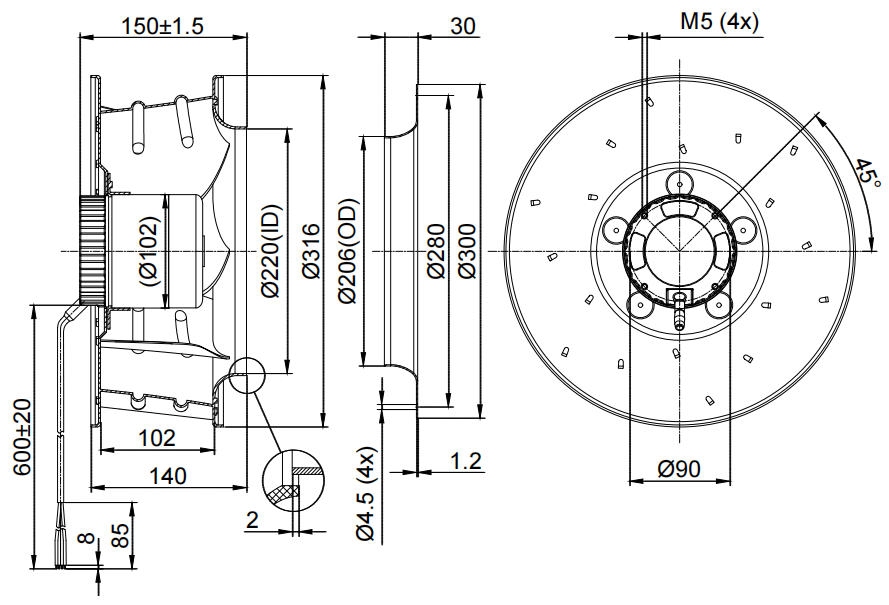
Facility procurement teams constantly seek measurable reductions in HVAC energy consumption. Backward curved fans achieve higher peak static efficiencies compared to alternative designs. These units routinely reach aerodynamic efficiencies above 80%. This high peak efficiency directly lowers daily power draw. Fans often run 24 hours a day in commercial environments. Even a fractional increase in efficiency saves thousands of dollars annually. When you maximize system efficiency, you relieve stress on the facility's power grid.
Noise pollution creates major compliance issues in modern buildings. Aerodynamic stability naturally translates to acoustic stability. Less internal turbulence equals lower sound power levels. Operating a low noise fan reduces your reliance on expensive secondary acoustic attenuation. Commercial air handling units (AHUs) and data centers benefit greatly here. You do not need to install massive sound baffles or thick acoustic lining. The equipment runs quietly right out of the box. This streamlines AHU design and reclaims valuable floor space.
Industrial air often carries dust, moisture, and debris. Forward-curved blades feature a "cup" shape. This cup catches and holds airborne dirt quickly. Airborne particulate builds up, causing severe imbalance. Flat or slightly curved backward blades lack this cup. Dust simply slides off the blade surface during rotation. This self-cleaning operational reality prevents excessive dust buildup. It minimizes dangerous imbalance risks. Preventative maintenance teams spend less time scraping fan blades. You extend the operational lifespan of the entire ventilation system.
Pairing these aerodynamic designs with modern motors multiplies the operational benefits. Integrating an Electronically Commutated (EC) motor yields a highly responsive system. An energy efficient fan requires precise, low-loss speed control. EC motors eliminate the mechanical wear often caused by traditional Variable Frequency Drives (VFDs). Building Management Systems (BMS) can communicate directly with the onboard electronics. You can adjust speeds dynamically based on real-time temperature sensors. This synergy reduces energy waste during partial-load conditions.
Choosing the correct fan requires understanding strict performance thresholds. Forward curved fans excel in specific environments. They work best in low-pressure, high-volume applications where space remains extremely limited. Residential furnaces often use them. However, backward curved fans dominate in medium-to-high pressure applications. Sustained efficiency becomes non-negotiable in large commercial setups. When ductwork stretches for hundreds of feet, pressure drops heavily. A forward curved unit will stall under this strain. The backward curved impeller maintains steady flow despite the rising resistance.
Every engineering choice involves spatial trade-offs. We must address the primary spatial drawback transparently. Backward curved fans generally require a larger housing diameter. They need this size to achieve the same airflow volume as a forward-curved unit running at lower speeds. If you have a highly compact air handler cabinet, fitment becomes challenging. The larger wheel diameter dictates the cabinet dimensions. Facility engineers must balance the need for high efficiency against the physical space available in the mechanical room.
Financial evaluations must look past the initial purchase order. Forward curved models usually present a lower initial capital expenditure. Their manufacturing process is simpler. However, backward curved units offer a rapid energy payback period. They draw significantly less amperage during continuous operation. Additionally, they experience reduced motor replacement rates. The self-limiting power curve protects the electrical components from early failure. The long-term financial returns heavily favor the backward curved design in continuous-duty scenarios.
Feature | Backward Curved Fan | Forward Curved Fan |
|---|---|---|
Static Pressure Capability | Medium to High | Low to Medium |
Peak Efficiency | Very High (Often >80%) | Moderate (Typically 55-65%) |
Motor Overload Risk | None (Self-limiting curve) | High (Power rises with airflow) |
Space Requirement | Larger footprint | Highly compact |
Debris Accumulation | Low (Self-cleaning shape) | High (Cupped blades trap dirt) |
Pharmaceutical and semiconductor manufacturing require immaculate environments. Cleanrooms rely heavily on HEPA filtration banks. HEPA filters degrade and load with particles over time. As they load, their physical resistance increases dramatically. Ventilation equipment must push consistent air volumes through these degrading filters. We cannot allow airflow stalling or surging. A backward curved unit easily overcomes this escalating static pressure. It ensures the laboratory maintains its required air change rates and positive room pressurization.
Server racks generate massive amounts of localized heat. Data center cooling systems operate in continuous, variable-demand environments. Heat loads shift across the server floor based on computing demand. Cooling systems require rapid, efficient pressure adjustments. Running an EC centrifugal fan in this environment provides distinct advantages. The fans ramp up instantly to cool hot spots. They drop speed smoothly when computing loads decrease. This variable response prevents overcooling and reduces facility power usage.
Manufacturing environments subject equipment to harsh realities. Process cooling and exhaust systems handle contaminated air streams daily. Slight particulate presence rapidly degrades other fan types. Forward blades quickly lose their balance. The self-cleaning geometry of the backward blade excels here. It sheds dust, maintaining structural integrity. You will find these units thriving in welding exhaust systems, chemical processing plants, and heavy manufacturing lines. They deliver reliable performance where delicate equipment fails.
Semiconductor Cleanrooms: Pushing air through dense HEPA filters.
Hyperscale Data Centers: Variable speed cooling for shifting IT loads.
Commercial Air Handling Units: Pressurizing large building duct networks.
Industrial Paint Booths: Exhausting fumes without massive debris buildup.
Upgrading legacy systems requires careful spatial planning. Evaluators must watch out for severe dimensional constraints during retrofits. Replacing existing forward curved fans in older AHUs poses challenges. Legacy cabinets were built around compact fan housings. A high-efficiency backward curved replacement needs a larger diameter. It might physically hit the cabinet walls. Assess the internal dimensions strictly before ordering. You may need to specify plenum fans (plug fans) without scroll housings to fit the available space safely.
Ignoring the physical fan width and depth limitations of legacy cabinets.
Failing to upgrade the electrical wiring for new variable speed controllers.
Overlooking the structural weight limits of existing AHU flooring.
Higher performance demands tighter manufacturing tolerances. Backward curved fans typically operate at much higher rotational speeds (RPM) than forward-curved alternatives. Because they spin faster, they require stringent dynamic balancing. You must ensure this balancing happens during initial installation. Even a slight imbalance will generate severe vibrations. Vibration destroys motor bearings quickly. It also causes acoustic issues throughout the ductwork. Demand certified balancing reports from your equipment manufacturer to ensure longevity.
Efficiency relies on correct application mathematics. You must accurately calculate the total static pressure of your facility. Selecting a high-efficiency backward curved fan for a zero-resistance system is a major error. It completely negates the primary efficiency advantages. These fans need resistance to perform properly. Operating them in open air causes them to run inefficiently. Ensure your ductwork, dampers, and filters provide the calculated pressure drop. Match the fan curve perfectly to your system curve.
System Parameter | Optimal Range for Backward Curved | Warning Thresholds |
|---|---|---|
Static Pressure | 2.0 to 10.0+ in. wg | Below 1.0 in. wg (Risk of inefficiency) |
Operating Speed | 1,500 to 3,500+ RPM | Vibration peaks require re-balancing |
Airflow Volume | Medium to Very High | Extreme low flow (Risk of surge) |
Selecting the optimal ventilation equipment dictates your facility's long-term reliability. We short-list backward curved fans when continuous operation, power consumption, and system resistance remain high. Their aerodynamic lift mechanism smoothly converts kinetic energy into static pressure. They reject dust buildup, operate quietly, and integrate seamlessly with modern building controls. These units prevent motor overloading, keeping your electrical infrastructure safe.
You must take actionable steps to secure these benefits. First, audit your current system's static pressure to ensure compatibility. Second, review all spatial constraints if you plan potential legacy retrofits. Finally, request specific fan performance curves and energy consumption calculations from manufacturers. Proper engineering evaluation upfront guarantees decades of stable, efficient airflow.
A: A non-overloading fan features a specific horsepower curve. The motor's power requirement peaks at a certain airflow and then drops as airflow increases further. This prevents motor burnout if system resistance suddenly drops, such as when an access door opens unexpectedly. You do not need to purchase oversized motors.
A: Yes. They operate efficiently without a traditional scroll housing. Engineers frequently use them as "plug fans" or plenum fans in modern air handling units. The unhoused fan pressurizes the entire internal cabinet, allowing air to exit through multiple duct taps efficiently and quietly.
A: EC (Electronically Commutated) fans integrate onboard speed control directly into the motor. This integration eliminates the mechanical wear and electrical noise induced by external VFDs. They maintain exceptionally high efficiency even at partial loads, making them perfect for variable-demand cooling systems.


