
Views: 0 Author: Site Editor Publish Time: 2026-06-01 Origin: Site


Industrial air movement demands extreme precision and unyielding resilience. Engineers face constant pressure to balance intense operational requirements against strictly enforced energy compliance. Unfortunately, underspecified fans often create severe bottlenecks for facility managers. They cause frequent motor burnout, unexpected system downtime, and massively inflated energy bills across operations. A failing fan can paralyze an entire production line in minutes, disrupting critical workflows.
Enter the backward centrifugal fan. It stands as the premier engineering standard for high-resistance, continuous-duty applications globally. This robust design handles varying pressures without compromising stability or electrical safety. This article provides a rigorous technical and financial evaluation framework. You will learn exactly how to select these specialized impellers over weaker alternatives when designing or upgrading a comprehensive air handling system.
Non-Overloading Power Curve: Backward-curved blades prevent motor burnout even if system resistance fluctuates.
Peak Energy Efficiency: Achieves up to 80-85% static efficiency, significantly lowering lifecycle operating costs.
Application Match: The default choice for systems requiring a high pressure fan (e.g., filtration, chemical processing, data center cooling).
Modernization: Combining these impellers with EC motors yields optimal part-load efficiency and system scalability.
Blade orientation determines how effectively a fan moves air against resistance. In a Backward Centrifugal Fan, the blades physically curve away from the direction of rotation. This specific geometry changes the fundamental physics of air movement within the housing. Instead of simply throwing air outward using brute centrifugal force, these blades generate pressure primarily through aerodynamic lift. They function remarkably like airplane wings slicing through the air. This lift-based approach creates a highly stable, smooth, and predictable airflow trajectory. You experience drastically fewer turbulent air pockets, which directly translates to less wasted energy and vibration.
The non-overloading characteristic stands as this fan’s most critical safety and reliability factor. Understanding this curve changes how engineers specify electrical components. As airflow increases past the maximum efficiency point—often due to a sudden drop in system resistance—power consumption actually drops. Forward-curved models do the exact opposite; they draw continuously more current until the motor overheats and fails. Because a backward-curved design self-limits its power draw, it inherently protects the electrical infrastructure. As a direct business outcome, engineers can size the motor precisely for the peak of the power curve. They safely avoid applying massive, costly safety margins. You do not have to purchase oversized motors just to prevent sudden electrical failures during unforeseen pressure drops.
Furthermore, these fans exhibit highly beneficial self-cleaning tendencies. The aerodynamic profile forcefully resists dust and moisture accumulation during operation. Contaminants slide smoothly off the backward-facing blades during high-speed rotation instead of building up on the leading edges. They outperform forward-curved alternatives significantly in moderately dirty environments. This keeps maintenance intervals predictable and reduces manual cleaning tasks. However, we must acknowledge a practical limitation. They are not pure material-handling fans. Heavy particulate loads, wood chips, or dense sludge still require dedicated radial fan configurations.
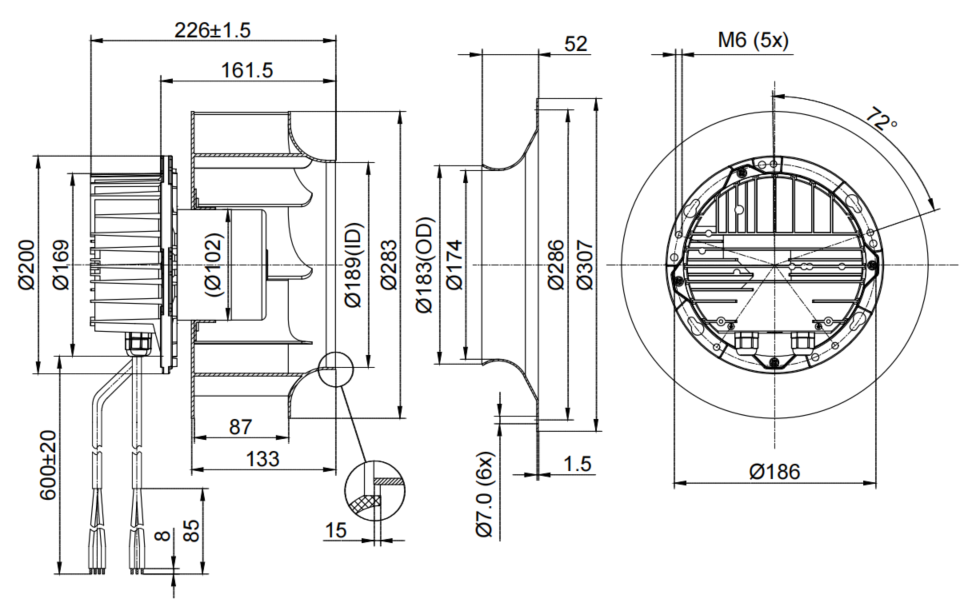
Making the correct structural choice dictates the long-term success of your ventilation strategy. A backward curved fan excels incredibly well under highly demanding static pressure conditions. It pushes air effortlessly through tight, high-resistance HEPA filters, complex duct networks, and dense heat exchanger coils. Conversely, forward-curved models struggle severely in these environments. They drop off sharply in operational efficiency as resistance climbs. They also risk catastrophic motor overload when static pressure spikes unpredictably. If your facility relies on extensive filtration, backward-curved blades remain the only viable engineering choice.
Energy efficiency highlights the most glaring difference between the two designs. You must contrast the metrics clearly to understand the operational impact. Backward-curved fans consistently achieve 75–85% static efficiency under normal load. Forward-curved models typically hover around a mediocre 55–65%. This huge gap shapes facility energy consumption dramatically over years of continuous use. You save enormous amounts of electrical energy simply by choosing the correct impeller geometry. To clarify these differences, review the performance comparison chart below.
Performance Metric | Backward-Curved Fan | Forward-Curved Fan |
|---|---|---|
Static Efficiency | 75% – 85% | 55% – 65% |
Pressure Handling | Excellent at high static pressure | Poor at high static pressure |
Motor Overload Risk | None (Non-overloading curve) | High (Requires strict current limits) |
Rotational Speed (RPM) | High | Low |
Physical Footprint | Slightly larger housing required | Highly compact design |
You must remain fully transparent about the engineering compromises involved. Backward-curved fans demand higher rotational speeds (RPM) to achieve the exact same airflow volume as forward-curved options. This requires precise dynamic balancing during manufacturing to prevent excessive bearing wear. Additionally, they command a slightly larger physical footprint in your facility. The scroll housing must be wider to accommodate the aerodynamic lift generation. Engineers must factor these dimensions into mechanical room layouts early in the design phase.
Heavy-duty construction perfectly matches the grueling 24/7 reality of modern manufacturing facilities. An industrial ventilation fan runs constantly in factory exhaust systems, chemical processing plants, and critical cleanrooms. These applications do not tolerate unexpected downtime. Backward-curved impellers utilize robust welding techniques, thicker steel or aluminum gauges, and premium bearings. They endure immense mechanical stress without warping or losing their aerodynamic balance. This durability ensures that volatile organic compounds (VOCs) and dangerous exhaust fumes leave the facility safely at all times.
The acoustic profile at high operational loads provides another massive advantage. The sleek fan design actively minimizes internal air turbulence as it moves through the housing. This smooth flow results in a much lower specific sound power level. The unit remains incredibly quiet when operating near its Best Efficiency Point (BEP). Noise reduction matters immensely for worker safety, OSHA compliance, and overall environmental comfort. You do not have to install as many expensive sound attenuators or bulky acoustic enclosures when the fan itself runs smoothly.
Regulatory compliance increasingly dictates facility engineering choices. Governments and regulatory bodies mandate strict energy consumption limits globally. High inherent mechanical efficiency helps modern facilities easily meet these stringent rules. You seamlessly satisfy ERP (Energy Related Products) directives in Europe. You conform perfectly to the latest ASHRAE energy standards in North America. By deploying high-efficiency impellers, facilities avoid hefty compliance fines and qualify for lucrative green-energy tax incentives. Regulatory bodies will only continue to tighten these standards over the next decade.
Modern engineering flawlessly bridges complex mechanics and advanced electronics. An EC centrifugal fan utilizes an Electronically Commutated motor, fundamentally altering how industrial ventilation operates. This technology elegantly pairs brushless DC motor architecture with integrated AC power conversion built directly into the stator. You get the extreme efficiency of a direct-current motor while simply plugging the unit into your standard alternating-current facility grid. There are no messy external conversion boxes or complex wiring schematics required.
This pairing acts as a massive efficiency multiplier. Combining a backward-curved impeller with an EC motor changes the entire performance landscape. It completely eliminates traditional slip losses found in standard induction motors. You maintain staggering efficiency even at partial operational loads. Traditional AC motors drop significantly in efficiency when you slow them down via frequency drives. EC motors, however, stay highly efficient across their entire speed spectrum. This ensures that when your ventilation demands decrease at night or during off-peak hours, your energy usage drops proportionally without wasting power as heat.
Facility managers increasingly demand granular, automated control over their environments. EC motors feature built-in IoT integration, including standard Modbus RTU and 0-10V analog control capabilities. This enables precise demand-controlled ventilation architectures. You scale power directly to real-time industrial requirements. If a temperature sensor in a data center detects a heat spike, it tells the EC motor to ramp up instantly. Once the temperature stabilizes, the fan seamlessly throttles back down. This creates a highly responsive, automated ecosystem that requires zero manual intervention from maintenance staff.
Transitioning to high-efficiency ventilation carries specific engineering risks. We heavily warn against casually estimating system curves. You must accurately map the exact system resistance of your ductwork before purchasing equipment. A backward centrifugal fan must be selected to operate exactly at its Best Efficiency Point (BEP). If you undersize or oversize the fan, efficiency plummets rapidly. Worse, you might trigger aerodynamic stall. Stall occurs when the air separates violently from the fan blades, causing intense structural vibrations, massive noise spikes, and immediate mechanical failure of the bearings.
Retrofitting challenges also require careful physical planning. You must address the harsh physical realities of upgrading an older, forward-curved unit. You have to adjust for physical space limitations, as the new housing might be wider. You need to accommodate the higher RPM requirements by ensuring your mounting framework can dampen different vibration frequencies. You also have to update your electrical motor sizing protocols to match the non-overloading power curve, ensuring you do not overpay for unnecessarily massive switchgear.
To navigate the motor selection process effectively, follow this strict logical path when choosing between VFDs and EC technology:
Assess current infrastructure scale: Massive legacy systems often favor retaining standard, heavy-duty AC motors but pairing them with new, external Variable Frequency Drives (VFDs). This minimizes total rewiring across large industrial plants.
Evaluate space constraints: Native EC setups offer incredibly compact, all-in-one designs. They entirely eliminate bulky external drives and complex wall-mounted cooling panels. This makes them perfect for tight mechanical rooms.
Analyze precision control needs: Modern systems requiring exact, real-time adjustments strongly benefit from direct EC motor integration. Their built-in microprocessors handle complex automation signals faster and more reliably than retrofitted VFDs.
The strategic implementation of backward-curved impellers revolutionizes industrial air management. While the initial capital expenditure often sits higher than legacy alternatives, the investment pays off rapidly. Extreme energy savings, absolute motor protection against pressure spikes, and vastly reduced maintenance intervals easily justify the upgrade. Engineers gain peace of mind knowing the non-overloading curve actively prevents catastrophic electrical failures during system fluctuations.
Before moving forward, buyers must take exact, real-world static pressure measurements of their ductwork. Do not rely on outdated blueprints. Consult a trusted manufacturer to run computational fluid dynamics (CFD) modeling or advanced fan selection software. Accurate modeling guarantees your new equipment operates securely at its Best Efficiency Point.
Do not let outdated ventilation bottleneck your production capabilities or inflate your utility bills. Map your system requirements today, explore comprehensive technical specification sheets, and consult with an industrial air movement specialist to custom-tailor your next installation.
A: Yes, they handle light to moderate dust well due to their shape, which resists buildup better than forward-curved fans. The backward-facing blades naturally shed moisture and fine debris during high-speed rotation. However, for heavy material handling, such as wood chips or industrial sludge, dedicated radial blades are required to prevent structural damage.
A: It ensures the fan's motor will not draw excessive current and burn out if the system pressure drops suddenly. For example, if an access door in the ductwork is left open, a forward-curved fan would over-speed and destroy its motor. A backward-curved fan naturally limits its power consumption, preventing catastrophic failure.
A: They run at higher RPMs, which can generate distinct noise frequencies. However, because they are highly efficient and create significantly less internal air turbulence, their overall acoustic footprint is often lower. When properly sized to the system's Best Efficiency Point, they operate quietly and require less sound attenuation equipment.


