
Views: 0 Author: Site Editor Publish Time: 2026-06-21 Origin: Site


Selecting the right air movement component is never just about maximizing free airflow. Engineers often learn this the hard way during product testing. When you pair a standard fan with high-efficiency media like HEPA or thick activated carbon, system resistance changes the physics of air delivery entirely. A mismatched fan quickly leads to steep performance drops. It also causes excessive noise and premature motor failure.
Airflow metrics look great on paper. However, evaluating a Air Purification Fan requires a deeper understanding of aerodynamic drag. This guide breaks down the critical evaluation criteria for modern systems. We cover everything from static pressure capabilities and motor efficiency to specific bearing types. Ultimately, we help engineering teams and advanced builders match the exact fan type to their specific filtration demands.
Static Pressure Trumps Free Airflow: Standard CFM ratings can drop by 35% to 80% once a HEPA filter is introduced. Fans must be evaluated on static pressure (ideally ≥ 2.0 to 3.0 mmH2O for HEPA).
Centrifugal Blowers Rule High-Resistance Systems: While axial fans move high volumes of free air, centrifugal fans are strictly necessary to push through multi-layer, dense filtration equipment.
EC Motors Drive ROI: Upgrading from AC/PSC motors to Electronically Commutated (EC) motors cuts energy consumption by up to 50% and doubles operational lifespan.
Bearings Dictate Longevity: Dual ball bearings heavily outperform sleeve/oil bearings in high-temperature, continuous-run clean air systems.
Many procurement teams face a common business problem. They identify a severe disconnect between spec-sheet performance and real-world system output. Standard testing measures airflow in a completely open environment. This open-air metric completely ignores the realities of actual device operation.
Dense HEPA-13 networks create extreme aerodynamic drag. These filters rely on tightly packed fiberglass microfibers to trap microscopic particles. Thick activated carbon beds add even more resistance. Carbon relies on densely packed pellets to adsorb gases and volatile organic compounds (VOCs). When air hits these layers, it struggles to pass through. This struggle creates severe pressure drop across the filter face. The fan must work substantially harder just to push a fraction of its rated air volume.
Engineers consistently observe massive airflow loss in lab testing. An open-air fan might boast a rating of 100 CFM. Once placed inside a sealed chassis behind a HEPA filter, that output plummets. The system might only deliver 20 to 65 CFM of actual clean air. This 35% to 80% performance penalty ruins expected air exchange rates. If you design a room layout based purely on free airflow, your facility will fail basic health compliance checks.
You must shift your focus from CFM to static pressure. We measure static pressure in millimeters of water (mmH2O) or Pascals (Pa). This metric represents the pushing power of the fan. It defines how well the fan overcomes physical resistance. A minimum static pressure of 2.0 mmH2O is absolutely necessary for basic pleated filters. True HEPA applications require a rating of ≥ 3.0 mmH2O to function efficiently. Without adequate static pressure, air simply bounces off the filter face and recirculates inside the fan housing.
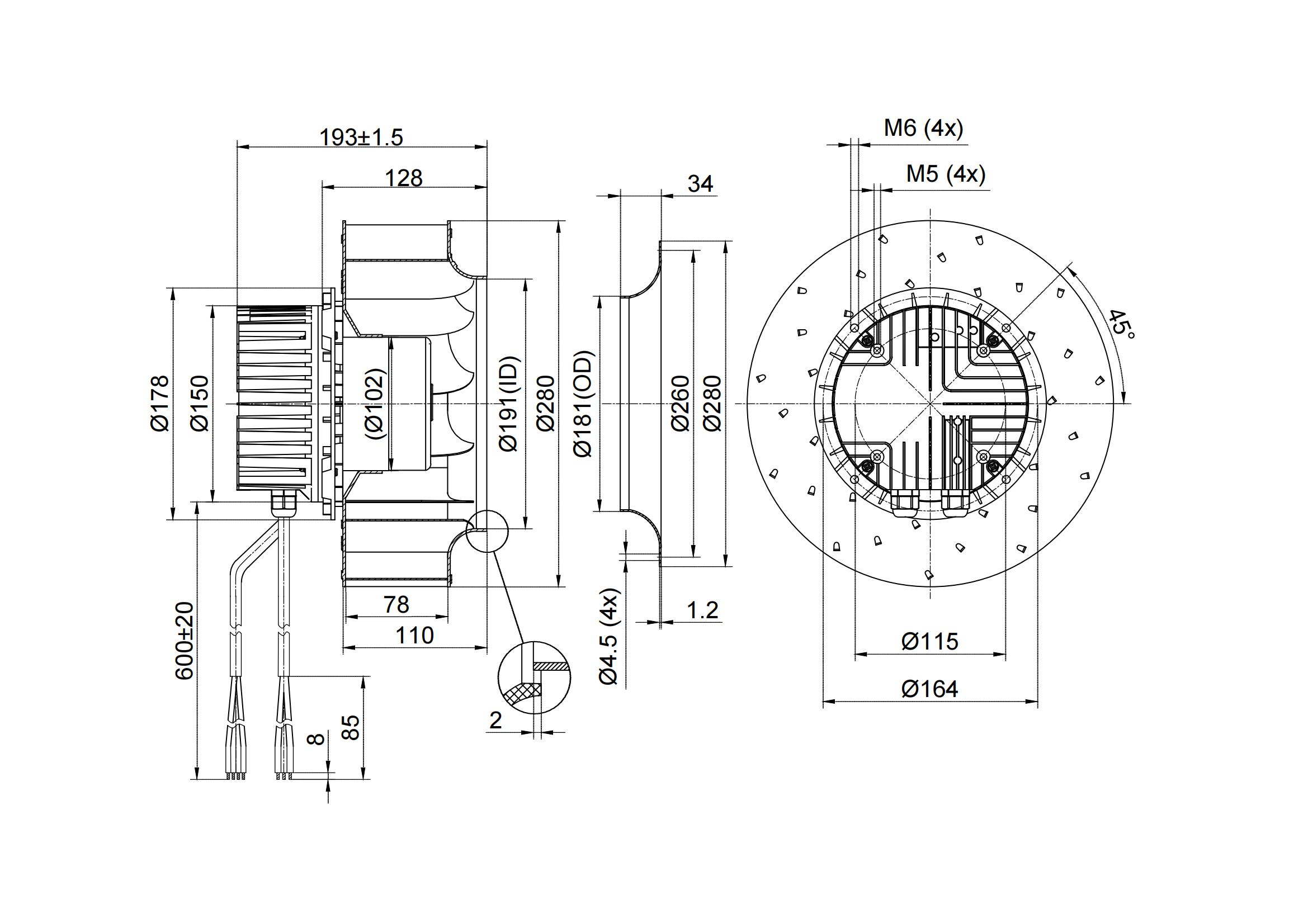
Different aerodynamic designs serve entirely different purposes. You must match the physical fan topology to the specific application. A wrong choice here guarantees system failure. Let us break down the core categories.
Axial fans operate much like an airplane propeller. They draw air in and propel it straight out along the same axis. They excel at moving massive volumes of air through open spaces.
Mechanism: Propels air straight through a cylindrical housing.
Ideal Use Case: Standard HVAC filtration, low-MERV pre-filters, or general electronics cooling.
Drawback: These fans fail rapidly against high-resistance HEPA media. The low static pressure causes airflow to stall against dense barriers.
A centrifugal blower utilizes a completely different aerodynamic approach. It resembles a squirrel cage. The blades spin to draw air into the center. Centrifugal force then flings the air outward, exhausting it at a 90-degree angle.
Mechanism: Pulls air into the impeller hub and forces it radially outward. This creates a highly concentrated, strong vacuum pull.
Ideal Use Case: Premium residential air purifiers and multi-stage HEPA/Carbon industrial systems.
Advantage: These blowers easily maintain high airflow even at resistance levels of hundreds of Pascals. They push through the thickest filtration media effortlessly.
Sometimes you need a middle ground. Mixed-flow fans combine the best attributes of both axial and centrifugal designs. They offer a unique structural compromise for specific form factors.
Mechanism: Merges axial flow characteristics with centrifugal pressure generation. The blades curve precisely to build pressure without a 90-degree turn.
Ideal Use Case: Compact units requiring perfect acoustic balance. They provide moderate static pressure while maintaining exceptionally low noise profiles.
Fan Topology | Static Pressure Capability | Free Airflow Volume | Best Suited For |
|---|---|---|---|
Axial | Low | Very High | Basic cooling, low-MERV pre-filters |
Centrifugal | Very High | Moderate | Dense HEPA, carbon beds, premium purifiers |
Mixed-Flow | Moderate to High | High | Compact devices requiring quiet operation |
The aerodynamic shell is only half the equation. The internal components determine ongoing operational viability. You must carefully assess motors and bearings to guarantee long-term performance for any filtration equipment fan. These choices directly dictate maintenance schedules and power usage.
Motor technology heavily influences energy consumption. The industry currently splits between traditional AC motors and modern electronic designs.
Permanent Split Capacitor (PSC): These traditional motors offer a lower upfront cost. However, they run significantly hotter. They also consume massive amounts of wattage. A mid-speed commercial unit might draw around 380W continuously. This heat generation forces surrounding components to degrade faster.
Electronically Commutated (EC): EC motors represent the modern industry standard. They utilize onboard electronics to convert AC power to DC internally. This process makes them incredibly efficient. They consume roughly 50% less energy than PSC variants. Furthermore, they easily last up to 90,000 hours. Facilities often use EC motors to qualify for green building programs or LEED points because they support programmable smart controls.
Bearings dictate the mechanical lifespan of the fan. Operating a unit continuously 24/7 places extreme stress on these small components. You have two primary options.
Sleeve bearings utilize a porous metal sleeve containing lubricating oil. They cost very little to manufacture. Unfortunately, continuous heat causes this oil to dry out rapidly. A typical sleeve bearing lasts roughly 20,000 hours. Once the lubricant evaporates, internal friction skyrockets. The fan begins to vibrate, and noise spikes exponentially before total failure.
Dual ball bearings solve this problem entirely. They use physical steel balls housed within a ring. This design heavily outperforms oil-based alternatives. Dual ball bearings easily achieve 50,000+ hours of continuous operation. They remain highly resistant to summer heat and heavy continuous-run loads. For dedicated clean air applications, they are the only acceptable choice.
Common Mistake: Procurement teams often select sleeve bearings to save pennies on the bill of materials. The resulting warranty claims and customer complaints regarding noise completely erase any initial savings.
Noise remains the single most common user objection in both residential and commercial spaces. A loud machine gets turned off. An offline machine provides zero purification. Managing acoustics requires early intervention during the design phase.
Most buyers misunderstand how sound stacking works. The decibel (dB) scale operates logarithmically, not linearly. Adding a second fan does not double the total decibels. If you have one fan producing 30 dB, adding a second identical fan creates 33 dB of total noise. Doubling the fan count only adds roughly ~3 dB to the total acoustic output. You can often use multiple quieter fans rather than one loud fan to move the same air volume.
Continuous operation requires careful acoustic targeting. You want the machine running constantly without disrupting conversation or workflow. For individual components, target a rating of ≤ 27 dB. This keeps the total system noise within the highly desirable 32–42 dB threshold. At this level, the unit sounds like a gentle background hum. It blends naturally into typical office or home environments.
You can drastically reduce noise by altering the size-to-speed ratio. Specifying a physically larger air purifier fan yields better acoustics. For example, choose a 140mm fan over a 120mm fan. Alternatively, select a larger centrifugal wheel. A large fan running at lower RPMs moves the exact same amount of air as a small fan spinning at maximum speed. However, the larger fan produces a significantly lower frequency. This lower noise floor feels much less intrusive to the human ear.
Building a robust clean air system requires strict mathematical sizing. You must prove the final output meets established industry health standards. Guesswork leads to poor air quality and failed compliance audits.
Effective particulate clearance relies on continuous air turnover. The Environmental Protection Agency (EPA) recommends a specific baseline. They advise achieving 4.8 air changes per hour (ACH) for optimal indoor air quality. This means the total volume of air in a room must pass through the filters nearly five times every hour. Achieving this standard dramatically reduces airborne viruses, allergens, and fine dust.
You calculate the required fan power based on the room volume and target ACH. Use this standard formula:
(Room Volume in cubic feet × Target ACH) / 60 = Required actual CFM (post-filter)
Always calculate using the post-filter CFM rating. Never use the open-air CFM rating. If a room requires 300 actual CFM, you might need a fan rated for 600 CFM in open air just to overcome the HEPA pressure drop.
High-end or cleanroom setups demand industrial Fan Filter Units (FFUs). These facilities must meet strict ISO Class requirements. Standard room circulation is insufficient. FFUs mount in the ceiling grid and push air straight down. This creates strict laminar airflow. Laminar flow prevents particles from swirling around the room. Furthermore, FFUs maintain positive indoor pressure. This positive pressure ensures contaminated external air cannot leak into the cleanroom when doors open.
Fan housing design directly impacts facility downtime. Topside replaceable units require technicians to lift the entire unit out of the ceiling. This breaks the cleanroom seal. The facility must halt operations and perform deep cleaning afterward. In contrast, Roomside Replaceable (RSR) designs allow single-person maintenance from below. Technicians simply drop the lower grille and swap the filter. This approach maintains positive pressure and keeps production lines running smoothly.
Choosing the correct air movement component dictates the entire success of a filtration project. A standard fan simply cannot perform miracles against thick media. Keep these critical points in mind before making your final selection:
Accept No "One-Size-Fits-All" Solutions: Standard filters may survive on simple axial fans. True HEPA applications unconditionally require the high static pressure of a centrifugal blower or an optimized mixed-flow unit.
Build an Ideal Spec Sheet: Always specify EC motors for superior energy efficiency. Demand dual ball bearings for long-term continuous operation. Insist on a static pressure rating exceeding 3.0 mmH2O.
Verify Real-World Output: Never trust open-air CFM numbers. Always validate the post-filter Clean Air Delivery Rate (CADR).
Consult the Experts: Encourage your engineering team to request detailed pressure-drop testing data from manufacturers. Match the exact fan curve to your specific filter resistance before initiating bulk procurement.
A: Yes, it can. If the fan is a low-static-pressure axial model, the excessive resistance blocks airflow. This causes the motor to overwork, overheat, and fail prematurely. Centrifugal fans are purpose-built to handle this load safely.
A: This typically signals a sleeve bearing failure. The internal lubricating oil dries out over time, causing severe friction. Alternatively, an undersized fan might be forced to run at maximum RPM just to push air through a dirty filter.
A: Carbon filters rely on densely packed pellets to capture gases. This creates immense aerodynamic drag. Adding carbon often reduces free airflow by 50% or more, depending entirely on the bed thickness and the fan's static pressure capability.
A: Consumer units focus on general room circulation in varied directions. Industrial Fan Filter Units (FFUs) are engineered specifically for cleanrooms. They provide strictly directed laminar airflow, maintain positive room pressure, and operate continuously under extreme efficiency tolerances.


